

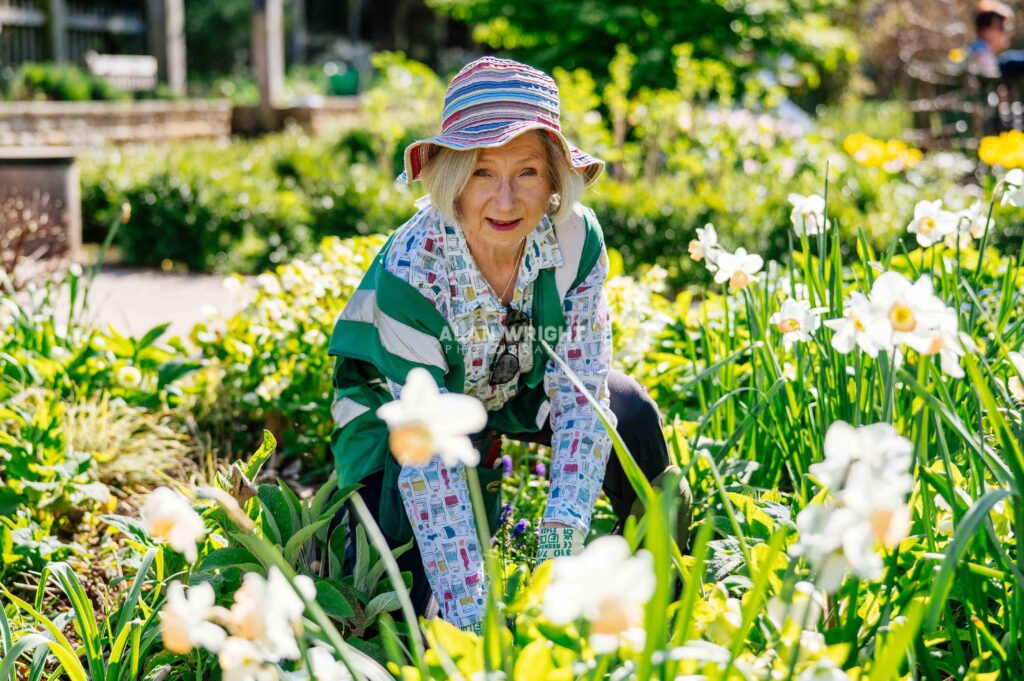
Carol Trowbridge in the Park House Sensory Garden (©AAH/Alan Wright)
Horsham Park will be protected in perpetuity after a legal agreement between Horsham District Council and the charity, Fields in Trust. The partnership follows a campaign by the Friends of Horsham Park to preserve the park for future generations. AAH met Sally Sanderson (Chair of Friends of Horsham Park), as well as volunteers Carol Trowbridge, Neil Marsh, Trevor Nash and Conor Weedon to find out more…
Sally: The Friends of Horsham Park was formed in 2017 by local people who objected to the installation of an ice-skating rink in the park. During our campaign, we uncovered various covenants concerning the park, but none offered complete protection from development. So, in 2019, we became a Community Interest Company (CIC) with the aim of enhancing, promoting and protecting Horsham Park. We now distribute a newsletter to 500 supporters, with a committee meeting held every month. Last year, our regular volunteer group recorded 2,442 hours of gardening and conservation work in the park.
Neil: We work closely with Horsham District Council’s Parks and Countryside team, who also look after other green spaces, such as Warnham Local Nature Reserve and Chesworth Farm. While the Council makes key decisions concerning the park, the Friends help to inform what is needed. Certain jobs must be carried out by qualified professionals, such as tree surgeons, but otherwise the Friends keep the park tidy, maintain flower beds, and promote habitats for different species.
Carol: Volunteers meet every Wednesday morning, come rain or shine. We try to cover the entire park, as there are a surprising number of flower beds that need attending. As well as popular spots such as the Park House Sensory Garden, there are beds around The Rec, along North Street, and around the duck pond too. It would be difficult for the Council’s own workforce to tend to them all without us.
Trevor: I recently joined the Friends, having previously volunteered for the Rudgwick Biodiversity Project. One of the great things about the Friends is the breadth of knowledge amongst the volunteers. I hope my experience will help the group to develop a greater understanding of the park’s ecosystems.
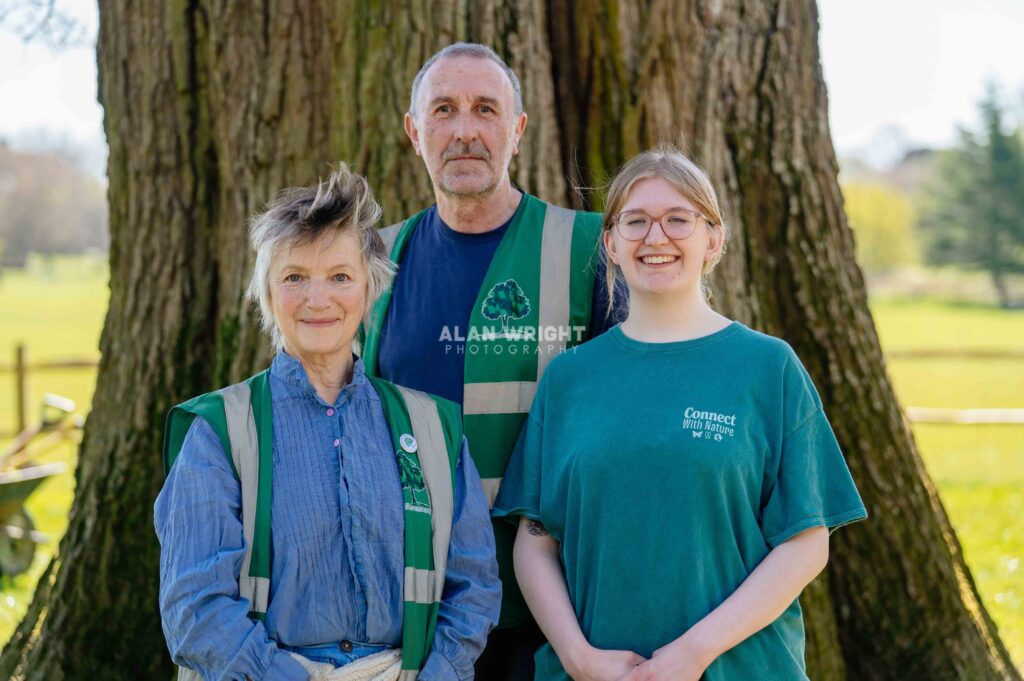
Mary Hinton, Neil Marsh and Maddie Jones at a protected oak (©AAH/Alan Wright)
Carol: I used to be a gardener by trade, before moving to Horsham to be close to family. A neighbour volunteered for the Friends and thought it would suit me too, so I joined her one Wednesday and have been coming ever since. Everybody gets on, as we have a shared interest.
Conor: Joining the Friends has had a big impact on my life. I’m an artist and also do leatherwork, but working alone can be isolating and I needed an outdoor hobby. I was at the park café one morning with my mum, and she encouraged me to approach the Friends, who were working nearby. Since then, I’ve been coming every week. Everyone has been very supportive and I’ve even started my own gardening business.
Carol: The Sensory Garden at Park House is one area that requires regular attention. The central beds are maintained by a professional gardener, while we tend to those around the perimeter. We promote variety, so have planted lavender – which attracts pollinators – as well as varieties that flower later in the year, such as hellebores. At the moment, it’s bursting with colour, with tulips and blue Brunnera. We’re also trimming the lonicera hedges, which needed re-planting after being munched by caterpillars!
Conor: I don’t have the knowledge of some of the more experienced gardeners, so tend to carry out labour-intensive tasks. Today, I’ve been doing a lot of heavy lifting, as we’ve planted some Heuchera near Park Surgery. It’s a busy access point between the town and the park, so we’re trying to make it more attractive.
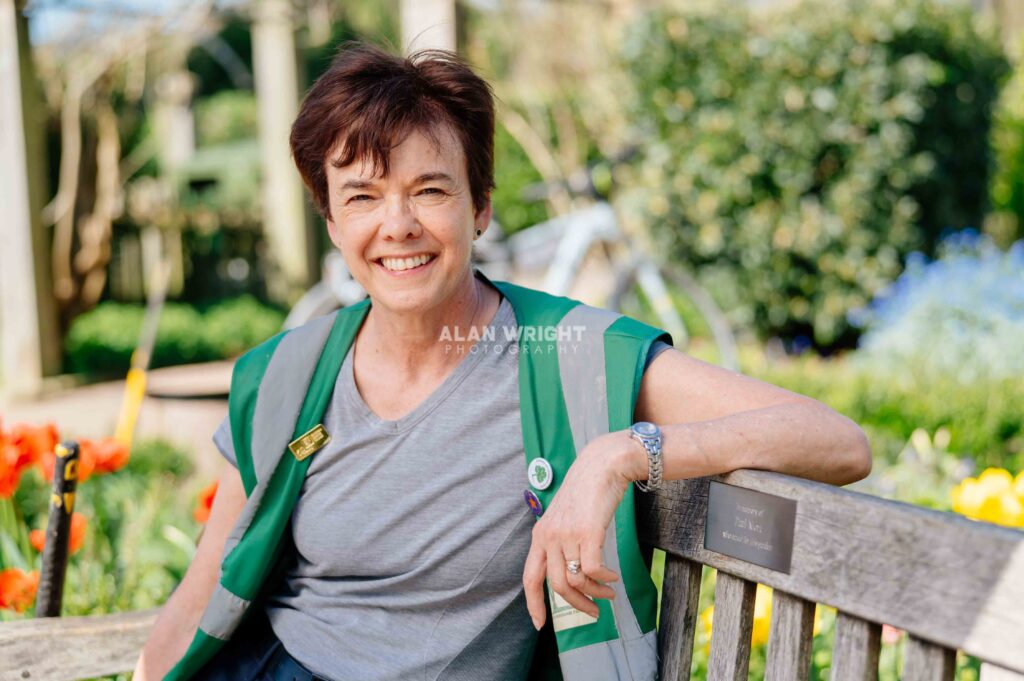
Sally Sanderson, Chair of Friends of Horsham Park (©AAH/Alan Wright)
Trevor: Many people enjoy the flowers in the Sensory Garden. However, other areas of the park are deliberately left alone and offer wonderful biodiversity. There is a growing understanding of rewilding and Knepp is a great example of what can be achieved, not just by leaving nature to its own devices, but understanding the impact that will have. People often remark on the beautiful flowers, but we also try to attract pollinators and support the park’s entire ecosystem.
Sally: As part of efforts to promote the park, we’ve supported events such as the St Catherine’s Hospice Midnight Walk, and work with the Horsham Society to offer guided walks. We also encourage people to vote for the park in competitions, winning gold in the Large Park category of RHS South and South-East In Bloom 2025. We regularly host litter-picking events too, and have received Keep Britain Tidy’s Green Flag Award by for six consecutive years. However, in a 65-acre park with features ranging from skate parks to dragon mazes, there’s always plenty to do.
Carol: Last autumn, we assisted with an extensive replanting of the Human Nature Garden. The garden was being looked after by a small team of volunteers who were pleased to hand it over to the Friends. It has a number of unusual shrubs, including pineapple guava, some lovely figs and mulberries too, which we kept where possible. It was mostly herbaceous plants that were replaced, with late-flowering perennials added for year-round colour. That’s the art of gardening: to offer something for all seasons.
Neil: One recent projects has been protecting a veteran oak tree. People were taking the desired path (rather than the one mapped out) which was compressing the tree’s roots. So, it was decided that it should be fenced off to protect it, with a new path created and wildflowers such as bluebells and primulas planted around it. We’ve also been helping the Council’s team replace some of the declining Fastigiate oaks lining the footpath from Park House with new native hornbeams.
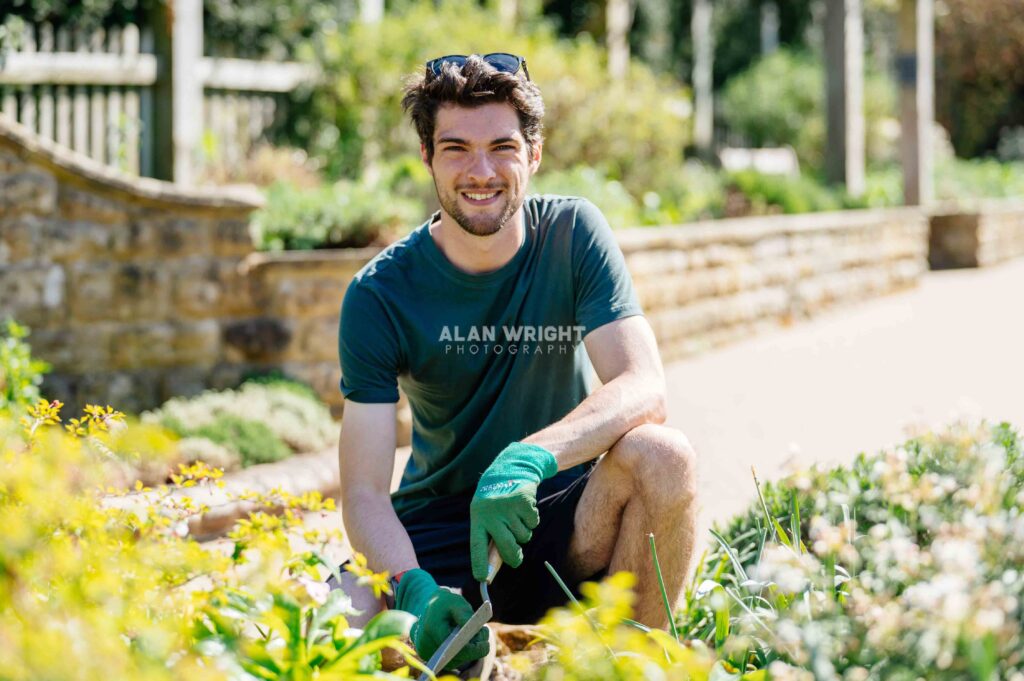
Joining the Friends inspired a career change for Conor Weedon (©AAH/Alan Wright)
Sally: We’ve been looking at ways to protect the park for some years. The original covenant stated that it should be used for recreation and public offices, which left some risk for development. In the 1970s, when Horsham Urban Council amalgamated with rural councils to form Horsham District Council, the Council proposed building offices for up to 300 employees in the park. It was largely the efforts of the Horsham Society which stopped this from happening. So, we wanted to ensure the park was protected before the introduction of a new Unitary Council covering Horsham, Crawley and Mid Sussex.
Sally: To provide this protection, the Friends started talking to Fields in Trust, a UK charity that legally protects parks, playgrounds and green spaces. Now, HDC has designated the park a protected public recreational space. If the Council ever wanted to build on it, they would have to provide an equivalent, high-quality 65-acre area of green space close to town, which would be very difficult! The protection doesn’t impact how the park is used; it excludes Council-owned buildings such as the café and bowls club – and it can still be used for sports. It also doesn’t stop the introduction of recreational facilities which may be deemed necessary in future. It simply provides peace of mind for the town.
Carol: People often comment on how lovely the park looks and thank us for our work. It’s nice to hear that our efforts are appreciated.
Trevor: We all share this beautiful space together – from children enjoying the play park and duck pond to older generations taking in the sights and scents of the sensory garden. So, I find helping care for Horsham Park to be good for the soul.
Find out more about the Friends online at: www.friendsofhorshampark.co.uk
Published in the June 2026 edition of AAH Magazine. Photos: Alan Wright Photography/ Words: Ben Morris