

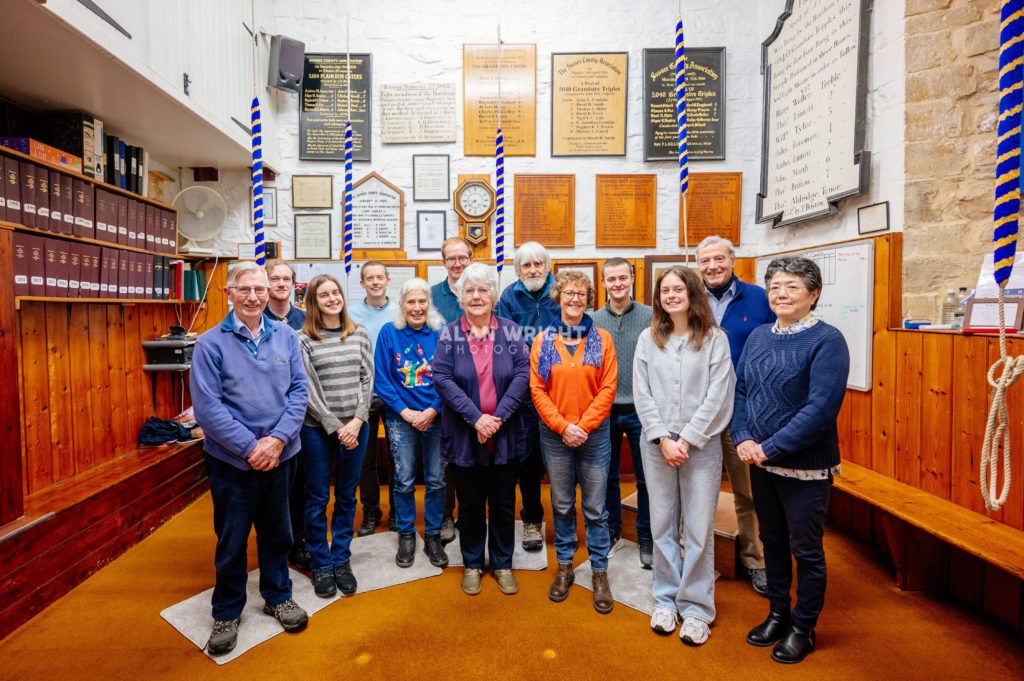
St Mary’s Church Bell Ringers (©AAH Magazine/Alan Wright Photography)
St. Mary’s Parish Church in Causeway, Horsham has an enthusiastic band of ringers, who ring the10-bell peal at Sunday services. St Mary’s Bell Ringers are affiliated to the Sussex County Association of Change Ringers, which aims to promote and support change ringing on bells in the county. They are therefore part of a closely-knit community, with several members also ringing at other churches, including St Margaret’s in Warnham (also home to a 10-bell peal) and St Mary Magdalene in Rusper (eight-bells).
While you’ll be forgiven for thinking that church bells ring randomly, it’s a physically and mentally challenging pastime, with performances ranging from basic patterns or ‘Rounds’, to popular tunes or ‘Methods’ and even ‘Peals’ that last for three hours, with the bells rung in patterns that are never repeated.
Tom Sutton, set to become Captain of St Mary’s Bell Ringers in March, said: ‘There are two main aspects to bell ringing. There is the physical aspect of pulling the ropes, in which timing is everything. A good technique is based as much on hand/ear co-ordination as hand/eye, as you’re listening to what you hear as well as what you see in order to control the bells. It also presents a mental challenge, as the patterns we ring can be complex and committing them to memory requires focus and concentration. I enjoy these challenges and love to hear the bells when the striking is consistent and clean. It is like an orchestra, in that your part is important, but ultimately your bell is contributing to a bigger sound.’
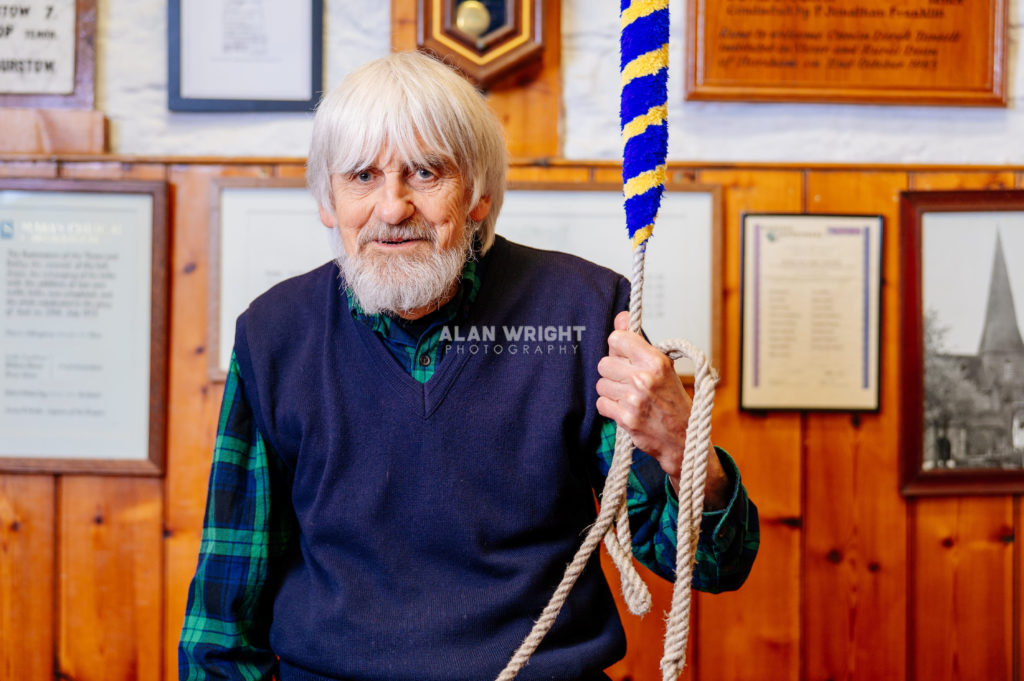
Stephen Pocock at St Mary’s (©AAH Magazine/Alan Wright Photography)
Stephen Pocock
Stephen was born in Horsham and is synonymous with bell ringing in the town. He first tried bell ringing with a school friend in 1967 and has been ringing ever since. His passion has taken him across the country, visiting numerous churches to ring and pursue his interest in history and architecture. He has always found the bell ringing community to be friendly and welcoming, and ensures the same is true in Horsham. Stephen explains a little about the history of the bells…
St Mary’s has a peal of 10 bells, hung in the west-facing tower, including a tenor that weighs 22cwt (a little over a tonne). It originally had eight, having become one of the first eight-bell peals in Sussex in 1752, although St Mary Magdalene’s in Bolney has the oldest ring of eight in the county. In 1973, St Mary’s became the fourth Sussex church with a ring of 10, allowing the ringers to perform a wider variety of methods and peals. Today, there are seven churches with rings of 10, with one ring of 12 (St Swithun’s in East Grinstead).
Two of the original eight bells from 1752 are still used at St Mary’s (bells 3 and 7), while others have been replaced over the years. Bells 4 and 9 were destroyed by a lightning strike that struck the Belfry on Christmas Eve 1814 and were replaced. Bell 4 broke again in 2023, after the mechanism jammed against the frame during practice for the King’s Coronation. Several of us travelled to John Taylor & Co in Loughborough to see the new bell cast. I had only seen hand bells being cast before, so it was wonderful to have a guided tour of the foundry.’
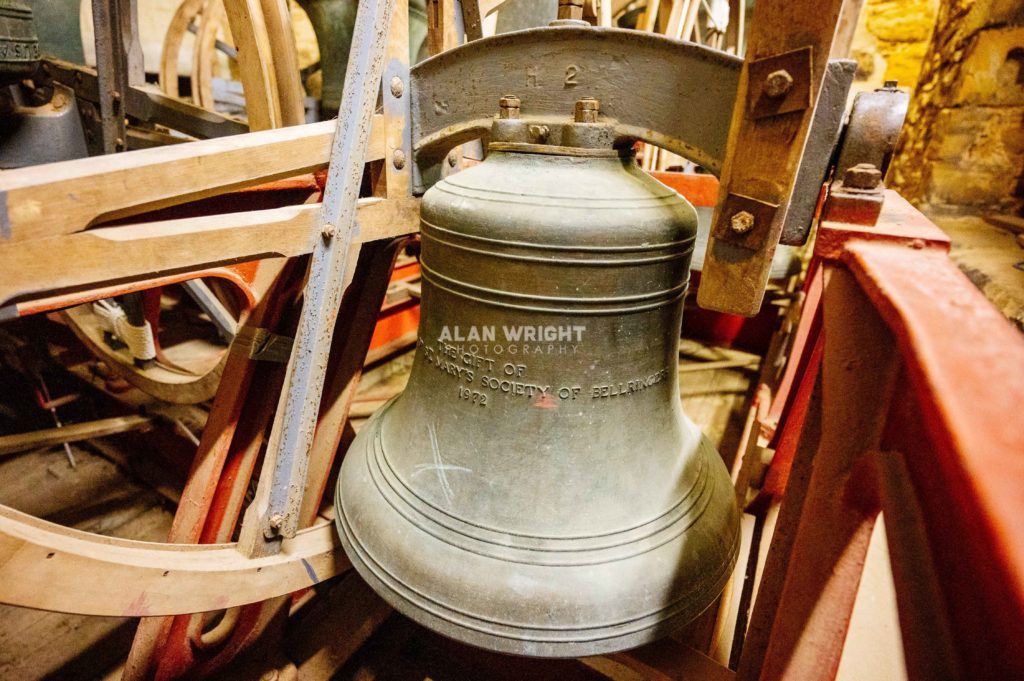
The bells of St Mary’s (©AAH Magazine/Alan Wright Photography)
Valerie Burgess
Valerie learned bell ringing as a teenager, when a church curate in Shirley, south London, encouraged a group of youngsters from the youth club to try it. She moved to Horsham in 1974 and has enjoyed ringing at St Mary’s ever since. She has been Captain of St Mary’s Bell Ringers on three occasions, with her current tenure dating back to 2010. Here, Val outlines the commitment involved in bell ringing…
We meet at St Mary’s every Tuesday night for practice, then ring on Sunday before two church services. We also perform at weddings and funerals too, although fewer people are married at the church these days. As Captain, it’s my responsibility to decide which rounds and methods we ring, and make any call changes.
We also ring special quarter peals, which last about 45 minutes, as we are helping to raise money for the restoration of the church’s Henry “Father” Willis organ. The work is expected to cost £150,000, so we are performing sponsored peals and quarter peals. We rang a quarter in January for a £250 donation, while another is being rung to celebrate a 50th wedding anniversary in April.
I’ve been playing quarters for so long that I don’t find it tiring at all, as it becomes second nature. However, the first time you play one, it seems to last forever, while a three-hour peal can feel like it’ll never end! People like Stephen and Tom ring peals all the time, at churches across the country, but I doubt I’ll ring a peal again. Peals are often commemorated on wooden boards or plaques, especially if they’re held on special occasions. I’m proud to have my name included on one peal board, hanging in the belltower at St Mary’s.’
‘I also love helping newcomers. I have made many good friends and even met my husband at Guildford Cathedral through bell ringing. We have three members over the age of 80 and I will be joining them next year, but I’m encouraged to see younger people joining too. There’s a wonderful bell ringing social side and larger community too, and we all still enjoy a drink together at The Bear after practice.’
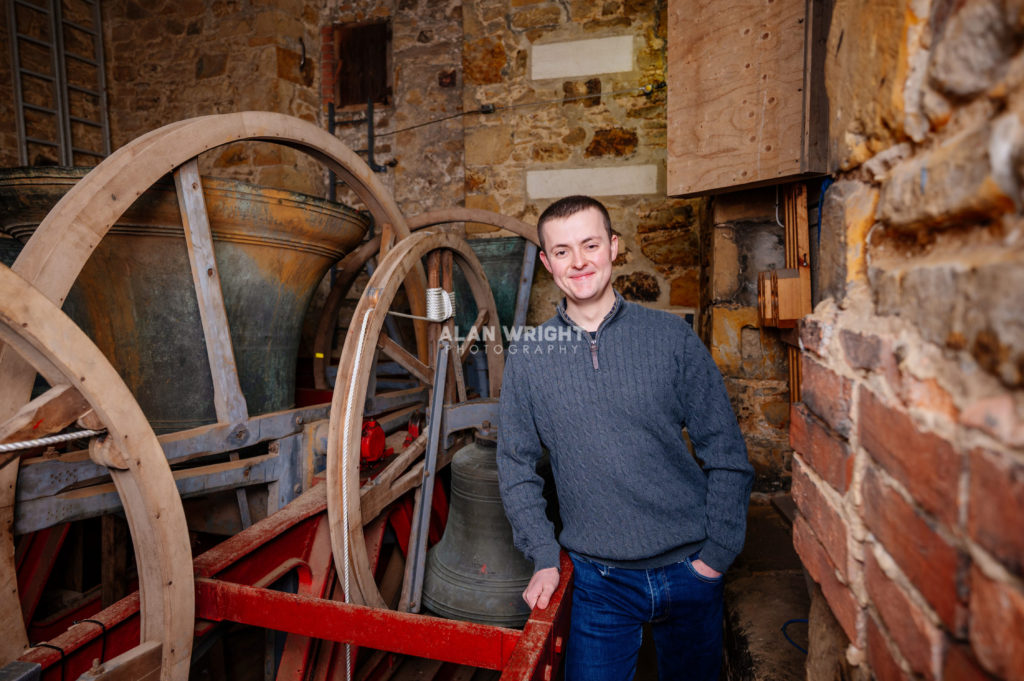
Tom Sutton in the Belfry (©AAH Magazine/Alan Wright Photography)
Tom Sutton
Tom started ringing bells from a young age, standing on boxes to reach the ropes at Bishopthorpe, York. After moving to Horsham for a job near Gatwick, Tom was inspired to rekindle a childhood passion after hearing the bells of St Mary’s while shopping in Sainsbury’s. Here, Tom describes the musical side of bell ringing…
Most of the time, bell ringing begins with Rounds, which is the simplest form of ringing. This is when the bells are rung in order, from the highest note (treble) to the lowest (tenor). As St Mary’s has ten bells, they will be rung from one to ten. We then have Call Changes, which is when the conductor or captain calls out an instruction. So, if they call “Two and Three”, we reverse the order for ringing those two bells. So, an order of 1-2-3-4 will become 1-3-2-4. Methods is the bell ringing word for a tune or song. In Methods, we follow a particular pattern, and although most people wouldn’t know what any of them are called, there are methods that will be familiar.
Finally, we perform feature length Peals or Quarter Peals. A peal involves three hours of non-stop ringing, which presents both a mental and physical challenge. During a peal, we ring at least 5000 rows (where each bell is rung once) and no single row is repeated. So, all 5,000 rows are different. You can’t call them randomly, as you’re bound to repeat some. So, you follow a pattern. We might begin with a standard round of 1-2-3-4-5-6-7-8-9-10 and alter each subsequent row by a single change. A seven-bell tower allows for a maximum of 5040 changes, so that’s quite a common Peal. A Quarter Peal involves 45 minutes of ringing, which tends to be around 1250 rows. These are often played during Evensong services.’
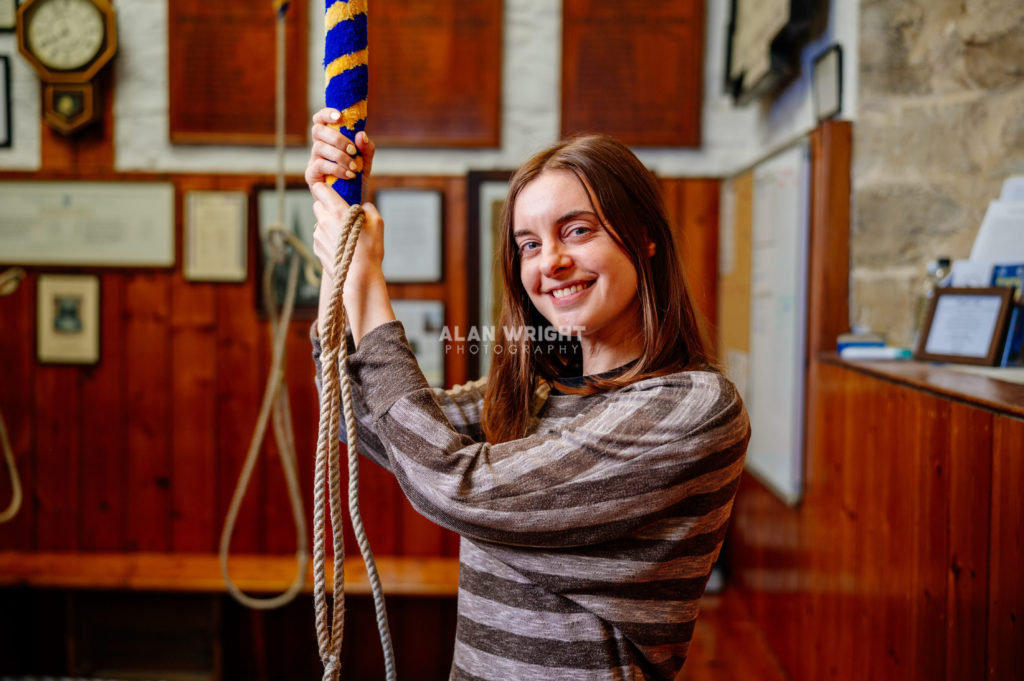
Rosie Oldham at St Mary’s (©AAH Magazine/Alan Wright Photography)
Rosie Oldham
Rosie grew up in Horsham and, as a child, loved hearing the bells on Tuesday nights and often talked about joining the ringers. After university, she settled in London, before her husband’s work brought her back to Horsham after a decade away. Upon hearing the bells again, Rosie finally decided to contact the group and attended a practice evening. Here, she outlines the challenges bell ringing presents…
I wasn’t involved in the church and didn’t know any other bell ringers, so my only interest came from the sound they made! I came along at the end of 2022, on a night when the bells were muffled, which I learned was because the Queen had died. Everyone was really welcoming. I think some of the older members want to ensure there will be enough ringers in the future, so they were eager to help and support me. I expected there to be very few younger people, so it was a pleasant surprise to meet others of a similar age. I have really come to appreciate speaking to people of multiple generations though, as there are very few places where that happens.
Bell ringing is difficult to perfect. In fact, it’s the hardest thing I’ve ever tried to learn! I’m not a naturally musical person – I don’t play an instrument proficiently and cannot read music, so it has taken me time to develop my technique and become attuned to the sound of the bells. I find bell ringing suits those with mathematical minds too, who are adept at learning patterns.
However, I enjoyed it from the outset. The challenge made me want to come back and – as with anything – the more you practice, the better you become. Most people are not familiar with the various rounds and methods that we play, and certainly wouldn’t hear any errors; yet in the belltower, everyone is focused on following the patterns and maintaining a steady rhythm, as it involves lots of concentration.
Now, whenever I visit other places, I always listen out for the bells and say to my husband, “That’s an eight-bell tower!” or “That’s a Whittington’s round!” I have also rung on VE Day and Remembrance Sunday, when people gather at the church to hear the bells and attend services. It does make me feel proud to play a small part during such occasions.
Further information: https://www.stmaryshorsham.org.uk/index.php/get-involved/st-marys-bell-ringers/
Originally published in AAH (All About Horsham) Magazine on 1st March 2026. Words by Ben Morris. Photography by Alan Wright.