

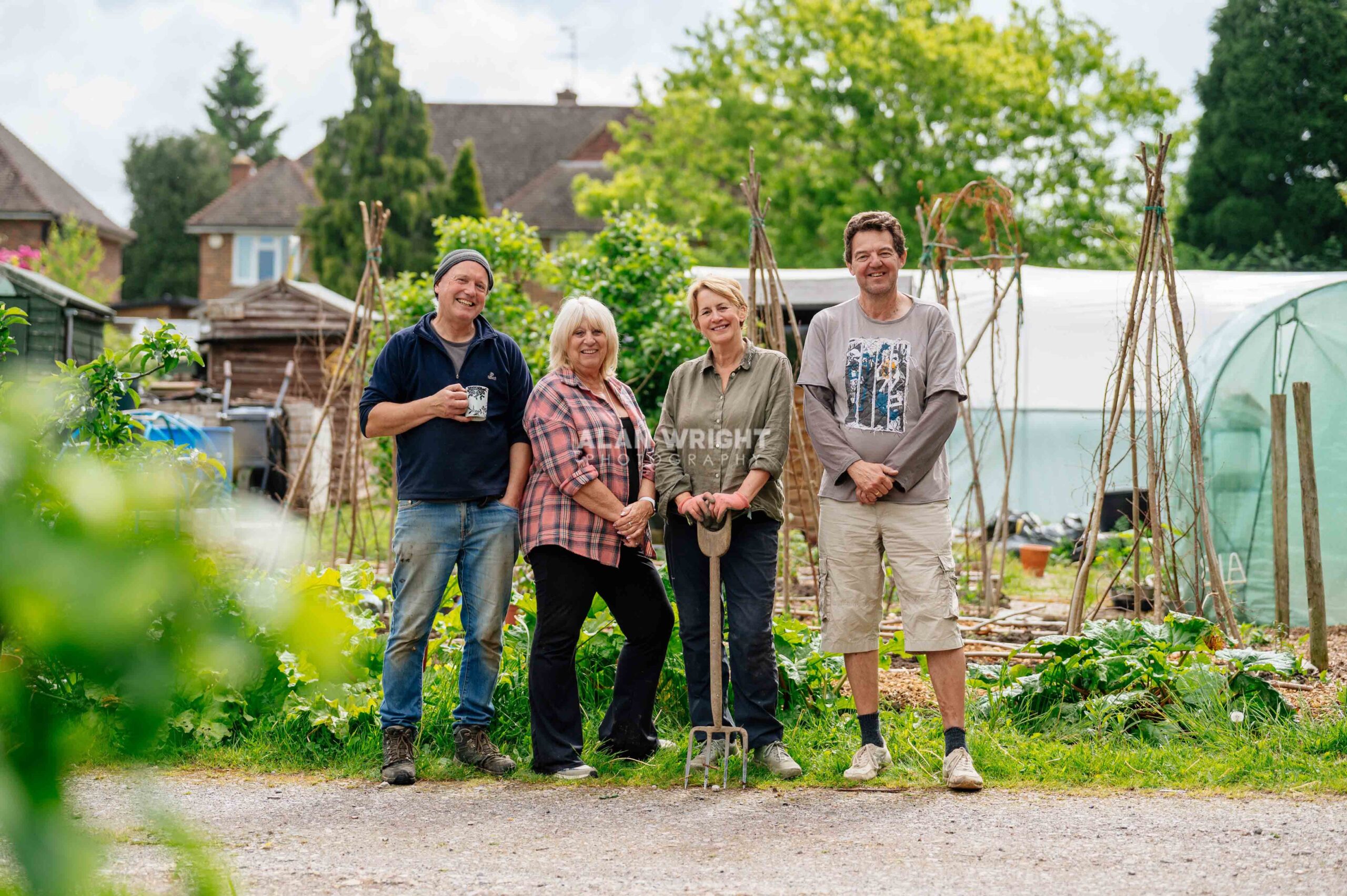
Chris Morris, Tricia Osgood, Rachel Barr and Nick Leach (©AAH/Alan Wright)
Shelley Allotments is a site of around 160 plots off Redford Avenue, Horsham. Last year, the volunteer-run Horsham Shelley Allotments Society (HSAS) re-opened a community plot. AAH met members of the committee, as well as volunteers, to find out more…
The Shelley allotments are hidden from passing traffic, accessible only via a narrow driveway. However, it’s one of the biggest allotments in town, with 135 individual plot-holders across its seven acres, growing a wide range of fruits, vegetables and herbs. There’s even a luxury chicken coop, known as Cluckingham Palace.
The site was initially designated for allotments as part of the ‘Dig for Victory’ campaign, when citizens were encouraged to grow fruit and veg to combat food shortages during the war. Although the land is owned by Horsham District Council, day-to-day operations are managed by the HSAS, founded in 1948.
Chris Morris, Treasurer, said: ‘Managing an allotment plot requires commitment. It can be very rewarding, but you reap what you sow and those who can’t put enough time into it won’t enjoy all the benefits.
‘Many people like the idea of an allotment, but it can be difficult to find the time to manage a plot around work and family commitments, which is why it tends to suit people as they get older. However, if you do have the time, it’s a great way to escape the hubbub of life and spend time outdoors.
‘The focus of allotment societies has changed too. Nowadays, there’s no urgent need to grow fresh produce to help the nation, as we can order potatoes and have them delivered to our front door in five minutes! Instead, the social and community benefits are more important, and people use allotments to meet new people and spend quality time outside.’
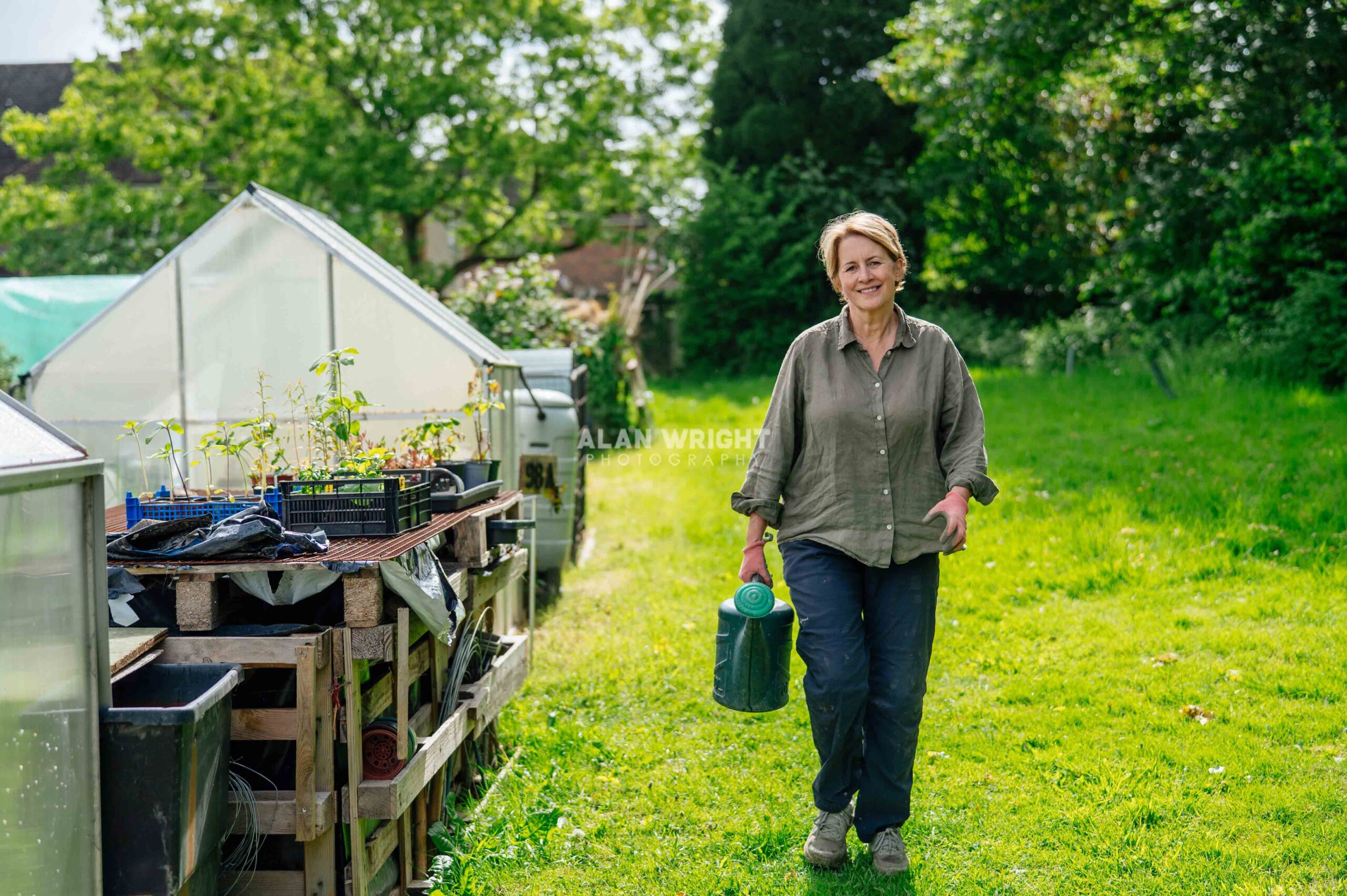
Rachel Barr helps run the community plot (©AAH/Alan Wright)
Community Plot
Rachel Barr has managed a plot at Shelley Allotments for nearly a decade. The 10-rod plot (one rod equates to about 25 square metres) is amongst the biggest on site and she uses it to grow strawberries, raspberries, blackcurrants, asparagus, courgettes and beans, as well as fresh flowers. Rachel also helps oversee the community plot. Located close to a shed which acts as a meeting point for the Society, the community plot provides opportunities for volunteers to grow fresh produce in a welcoming environment.
Rachel said: ‘The HSAS committee felt it would benefit the community if we could provide a plot where anyone can get involved. That could be someone who can no longer manage their own plot but still enjoys the social aspects of the allotments; someone who wants to grow produce but doesn’t have a garden of their own; or someone who likes spending time outside and wants to connect with like-minded people, as we all know the mental health benefits. We already had a small community plot, which included a poly-tunnel and greenhouse. When an adjacent plot was given up, we took the chance to extend it. We now use it to grow strawberries, raspberries, blackcurrants, rhubarb, sweet peas, potatoes and leaks, as well as tomatoes, cucumbers and aubergines in the poly-tunnel. We also grow flowers and hope to create a herb garden in future too. As it’s for the community, much of what is grown is donated to the Horsham Food Bank, along with glut from other plots.’
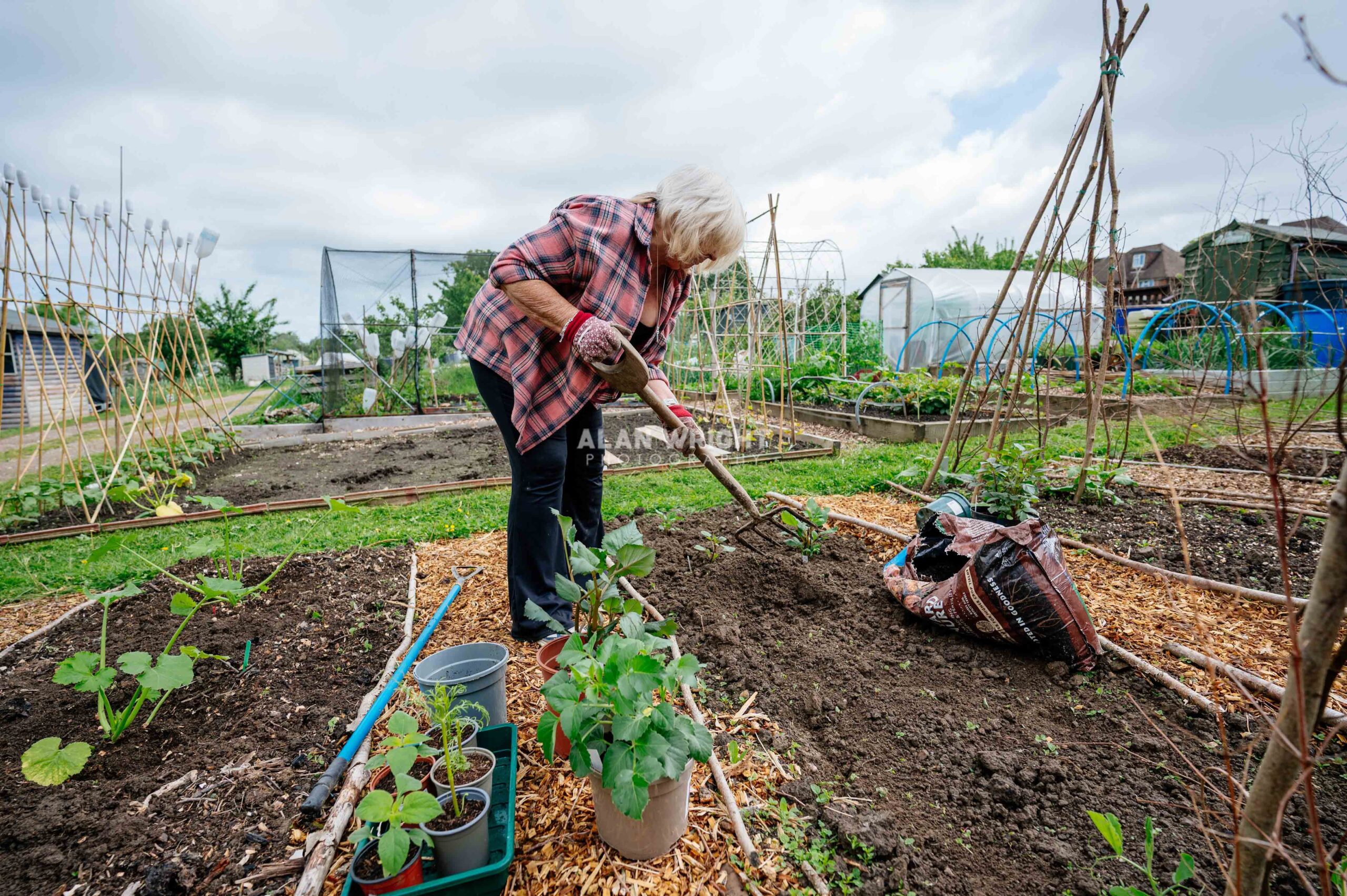
Tricia Osgood at Shelley Allotments (©AAH/Alan Wright)
Social Benefits
Tricia Osgood is one of the volunteers. Trish was a hairdresser in the Roffey area before moving to Cornwall. After years away, she returned to Horsham to be close to her grandchildren. To help meet new people and spend more time outdoors, Trish searched for local volunteering opportunities through a social subscriber, who felt the allotments were a perfect fit…
Tricia said: ‘I didn’t know anything about gardening, but knew I wanted to be outside. I came along for the first time last June and hit it off with Rachel immediately. Even though I have family in the area, I was quite lonely, so the allotments have saved me, in a way. Everyone has been so friendly and welcoming, and I’ve learned a lot too.
‘I attend every Wednesday and Rachel doesn’t expect too much of me. There’s no pressure – I just do what I can – and I’m always laughing with other volunteers. For me, it’s about companionship and friendship. I lived in a Cornish village where everyone knew everyone, and feel that same sense of community at the allotments.’
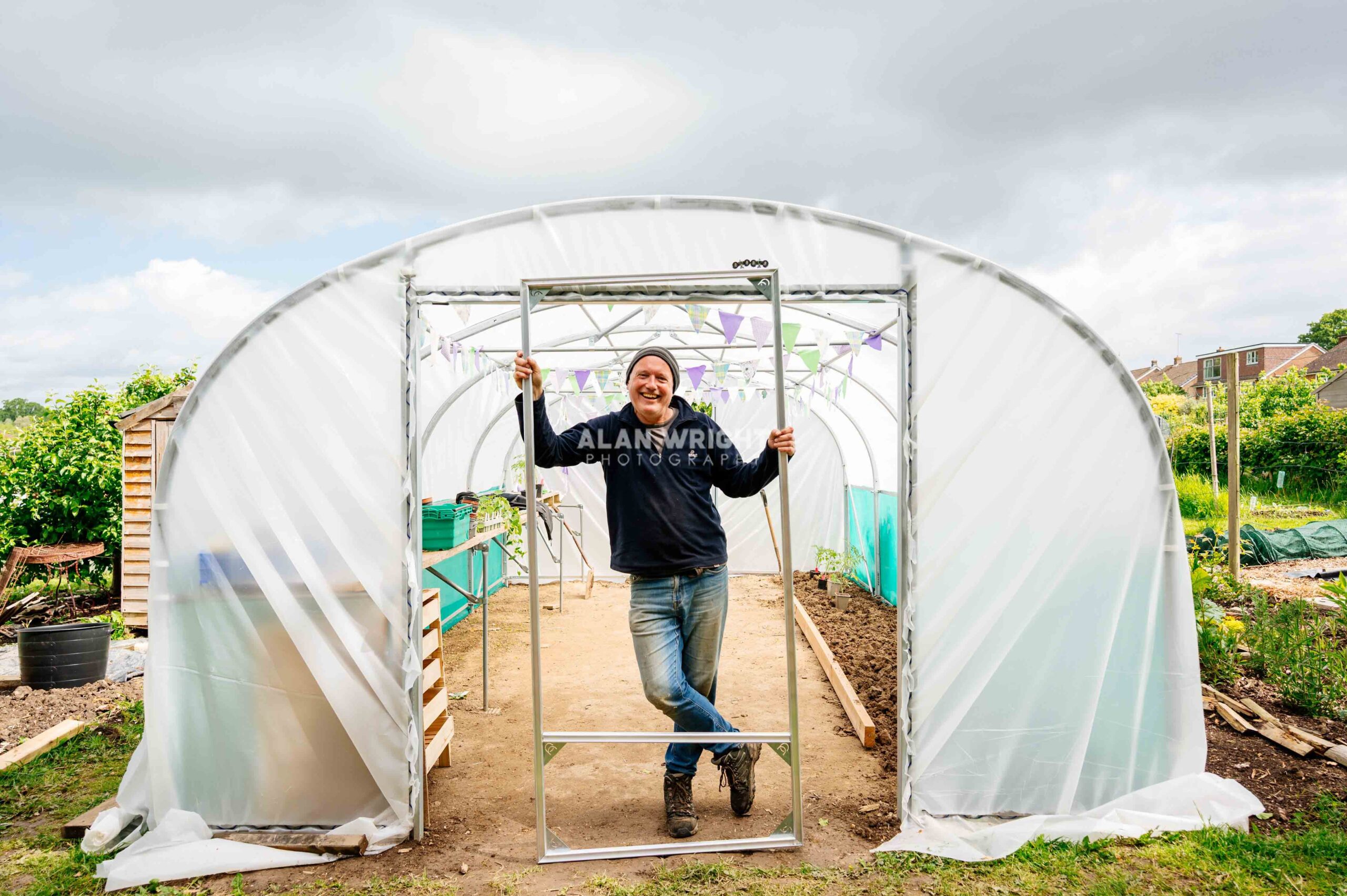
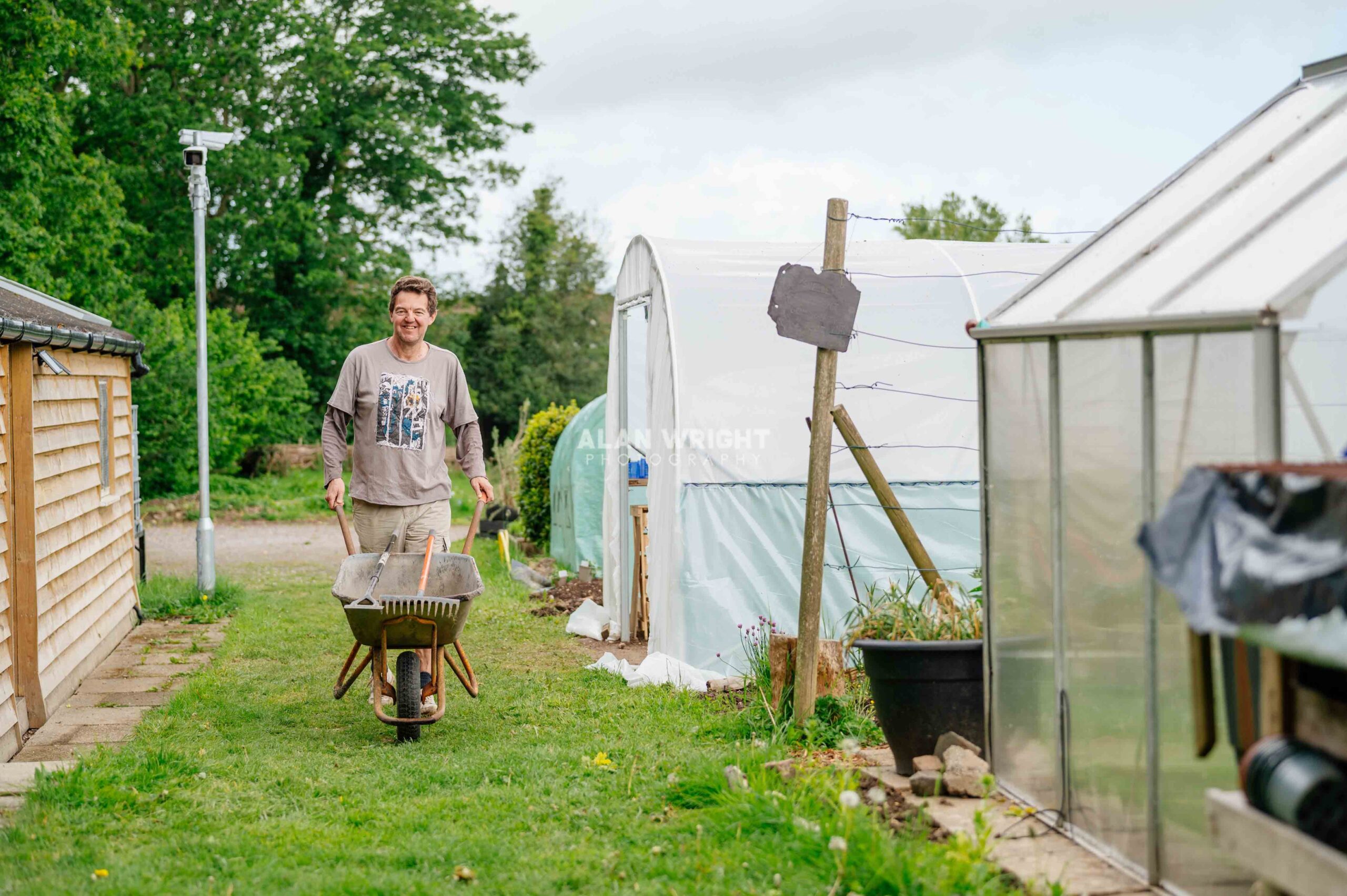
Chris Morris in the poly-tunnel (©AAH/Alan Wright)
Green Initiatives
The growing sense of community has been further aided by summer barbecues and regular working parties, where plot owners come together to focus on a particular area of the site, perhaps clearing a dead hedge or a derelict plot. Seed swaps provide another opportunity to share ideas, as well as produce.
HSAS has introduced several green initiatives too. These include new composting areas and solar panels on the shed, while chemicals and synthetic materials have been banned on site.
Nick Leach, Chair of the Society, said: ‘We want to be ecologically responsible. Three years ago, when I first became actively involved, we endured a hot spell from May to July and used almost 750,000 litres of mains water. As well as being morally irresponsible, it was expensive and treated water isn’t really best for plants either. So, we are now working towards becoming self-sufficient and water neutral. We secured grant funding for Industrial Bulk Containers (IBCs) which can store 1,000 litres of water, and introduced six across the site. We plan to add more, so that every plot owner will be within a short walk of rainwater, as we move towards water neutrality.
‘There is also a stream around the site which feeds into Red River, so we have an ambitious idea to build an artesian well in future, with the long-term goal of being water positive. In addition to all of these sustainable schemes, we try to achieve a good balance to ensure that this is a fun and sociable place to be.’
Nick Leach has helped introduce green initiatives (©AAH/Alan Wright)
Fantastic Foxes
The Society is also trying to create a green corridor to help protect wildlife. Despite its urban surroundings, the allotments are rich in fauna, as well as flora. Joy Carter grows a variety of produce on her plot, from Swiss chard to pumpkins, using these ingredients to try out new recipes, such as beetroot-top fritters and carrot-top pesto. However, Joy is also a nature lover and compiles a list of birds seen on the allotments.
‘I started keeping an annual list 15 years ago, to monitor the rise or decline of birds on site,’ said Joy. ‘The allotments are surrounded by thick hedgerows, so we have seen the black cap, bullfinch and chiffchaff, as well as birds of prey including the red kite, kestrel, buzzard, sparrowhawk and Tawny owl. I also look out for butterflies and we’ve seen the painted lady, red admiral, holly blue, peacock and speckled wood. We’re hopeful of seeing hairstreak varieties return this summer too.
‘Other plot holders have come across slow worms, while I arrived one morning to see a deer in my plot. Foxes are regular visitors, sometimes with kits too. Most of us have protective netting to protect plots from wild foragers, but I think it’s wonderful that we share the site with so much wildlife.’
Article first published on 1st July 2026. Photos: Alan Wright Photography; Words: Ben Morris.