

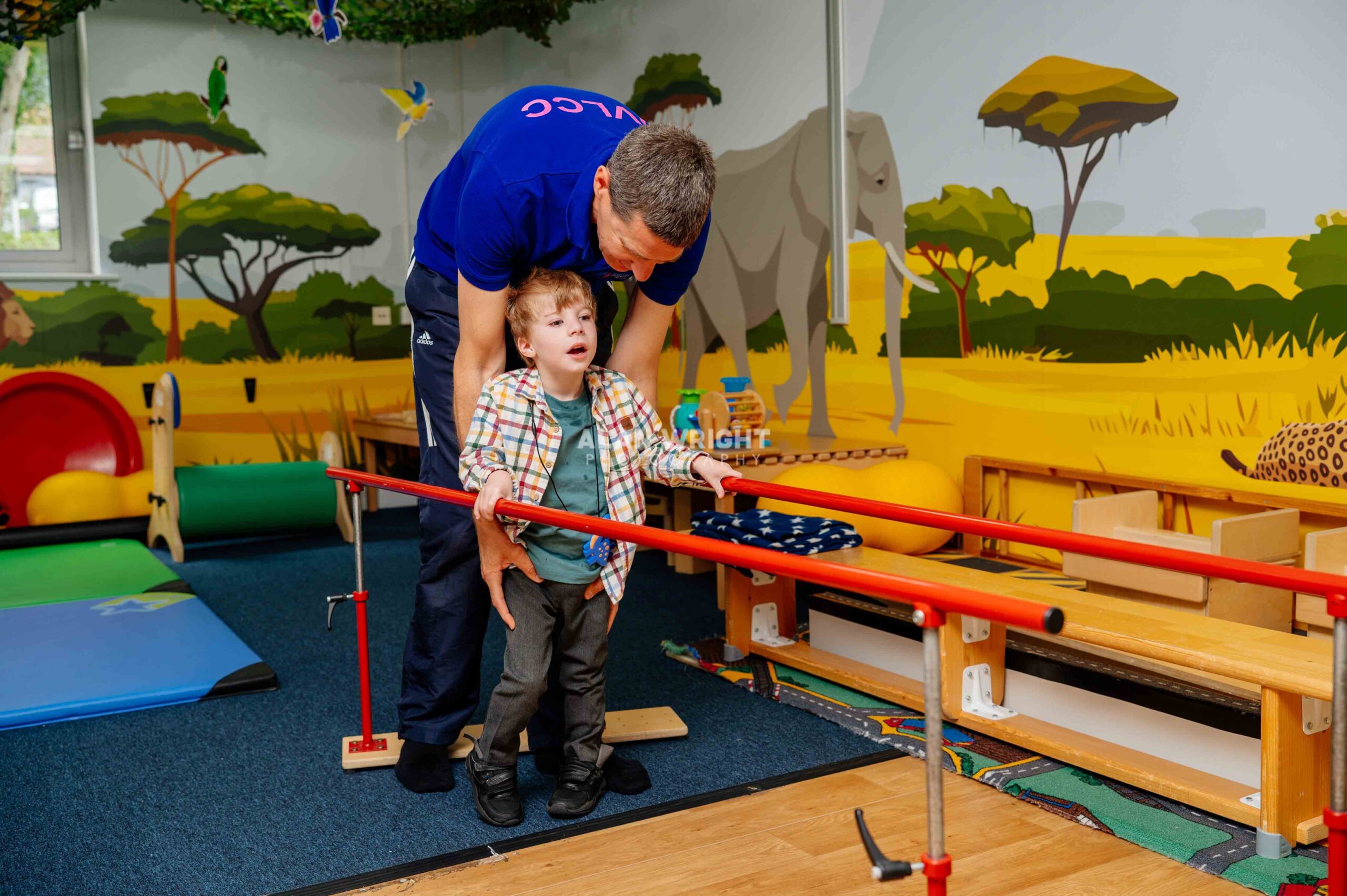
Freddie enjoys a play session at DVLCC (©AAH/Alan Wright)
Dame Vera Lynn Children’s Charity is celebrating its 25th anniversary this year. The charity provides support to babies and young children living with cerebral palsy and other motor learning impairments. AAH visited the charity in North Chailey to find out more…
When it comes to telling the story of this remarkable charity, it seems natural to start by asking what compelled Vera Lynn – the entertainer who perhaps defines the term “Forces’ Sweetheart” more than anyone else – to establish a special school in the Sussex countryside.
‘It’s the question everyone asks,’ smiles Glenys Creese, who has served as CEO for six years. ‘After all, as far as we know, she didn’t have any family or friends with cerebral palsy or similar impairments. I spoke to Dame Vera over tea and cake when we celebrated her 100th birthday, and she explained that her interest in children with cerebral palsy dated back to the 1950s. She even helped establish another charity, S.O.S, and was later a long-serving supporter of Scope.
‘When Scope stopped funding its early intervention service for young children, Dame Vera called on the support of influential friends and colleagues to launch the Dame Vera Lynn Trust (later re-named Children’s Charity) in 2001. She was 86, yet still committed to establishing the charity, which speaks volumes about her. She felt a synergy between her previous support for British troops – her boys, as she called them – and the services she provided for children and their families.’
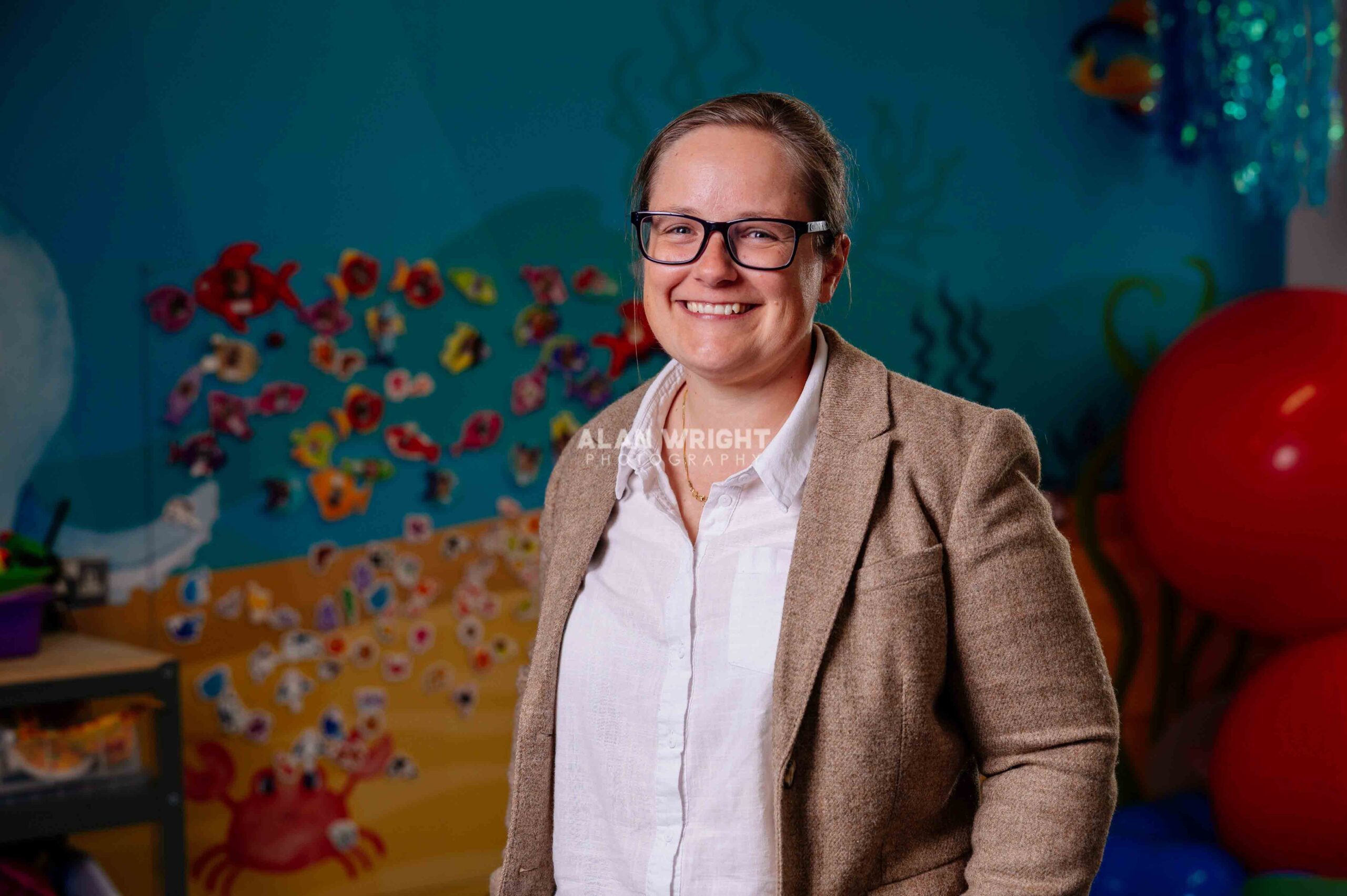
Glenys Creese, CEO (©AAH/Alan Wright)
GOLD DUST
DVLCC established a School for Parents, supporting families with babies and children under five with cerebral palsy, chromosome abnormalities, or rare genetic disorders that affect physical development. This school was initially based in the grounds of Ingfield Manor School at Five Oaks, nr Billingshurst, which at the time was run by the disability charity, Scope. The partnership lasted 15 years, with some children at the School for Parents then continuing to receive support at Ingfield Manor through primary, secondary and sixth form years.
However, fundraising was becoming more challenging. Significant grant contributors, such as Children in Need, were already supporting Scope, so were reluctant to fund the DVLCC too, as some of its money would also be used to pay Scope for its services. Faced with the option of closing or becoming independent, the charity’s trustees chose the latter. The DVLCC left Five Oaks in 2016 and moved to a new venue in Cuckfield. Since then, it has employed its own staff, including paediatric physiotherapists, speech and language therapists, and outreach workers.
In 2024, after eight years in Cuckfield, the charity moved to its current location within the grounds of the Chailey Heritage Foundation. It continues to provide free sessions through to a child’s 6th birthday.
Glenys said: ‘The charity has grown from Dame Vera Lynn’s original vision into a vital regional service. We attract families from across Mid Sussex, Horsham and Crawley, as well as Hampshire, Kent and even London. Families are willing to travel as they cannot find all of the specialist therapy services we provide under one roof anywhere else. As well as physiotherapy, music, and speech and language therapy, we provide home play sessions through our Outreach team. We also offer hydrotherapy in Horsham, rebound therapy, and baby massage for new parents.
‘We’ve also introduced a parental support service, so there’s always a counsellor families can talk to. The parents often become close friends too, and I’m reminded of a group of boys who used to attend our Wednesday morning sessions. They are all nine-or-ten now, but their parents continue to meet socially and even organise weekends away together. It’s important to have that support network, so we ensure this is a space where they can talk openly, which is good for their wellbeing.
‘We see about 100 children a week, and even after 25 years, occasionally come across a child with a diagnosis which is new to us. However, our therapists are very experienced when it comes to providing the right support. The work can be emotional, and we need to support one another, especially when a child passes away – something you never get used to. But on a more positive note, we get to see a child walking when their parents have been told that could never happen, or see them communicate for the first time. These moments are like gold dust.’
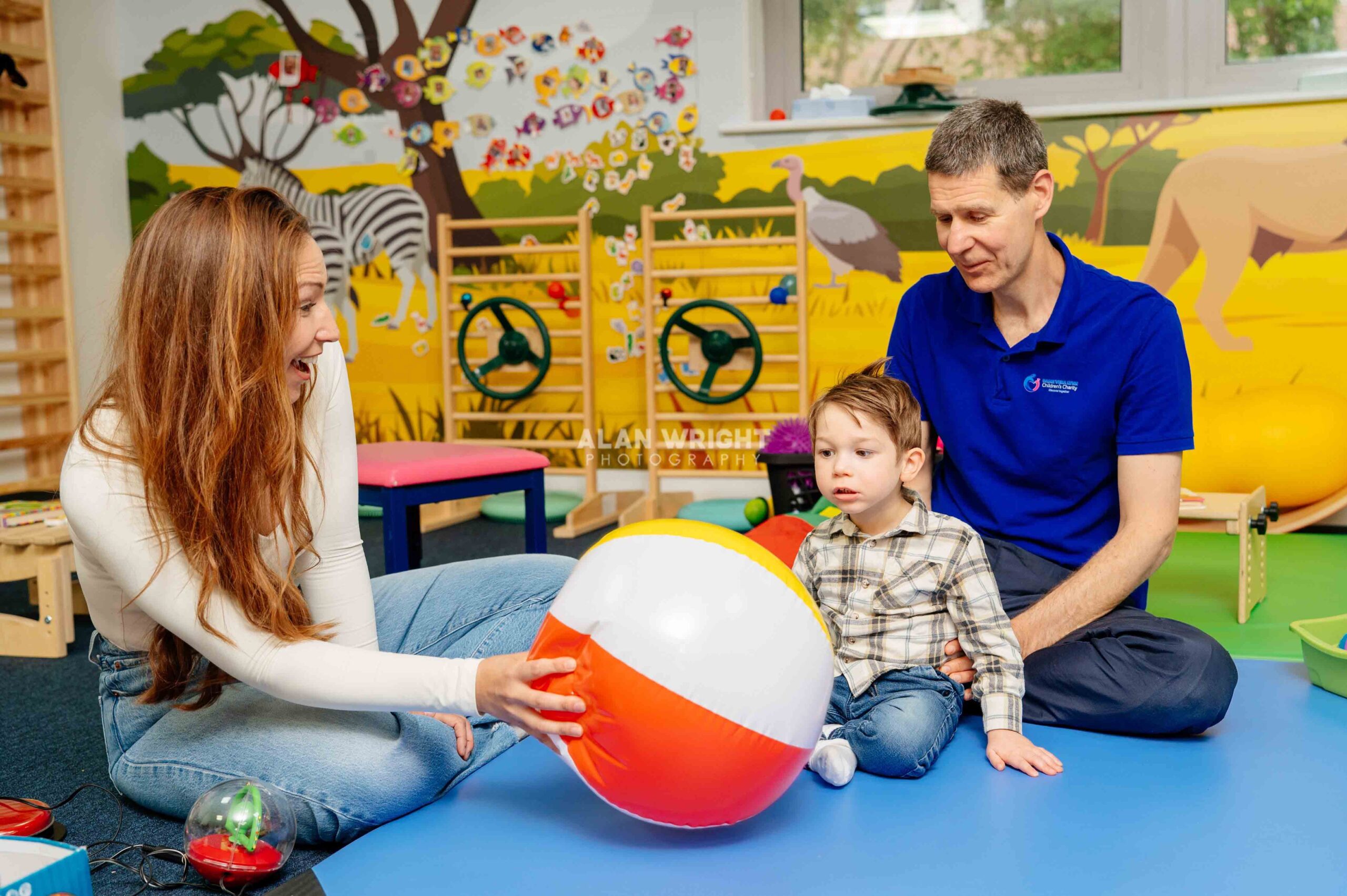
Anna and Freddie with physiotherapist Istvan (©AAH/Alan Wright)
PRECIOUS TIME
For parents like Anna Lee from Warnham, the service the charity provides is worth its weight in gold. Anna’s son Freddie, who turned three in March, has Galloway-Mowat syndrome, a rare genetic disorder characterised by early-onset progressive kidney disease and severe neurological abnormalities.
As a midwife at East Surrey Hospital, Anna was surrounded by colleagues when she gave birth to Freddie at home. There were no complications, but after six months, Anna and her partner were concerned that Freddie wasn’t meeting his physical and communicative milestones.
Anna recalled: ‘Freddie wasn’t sitting up or rolling as you’d expect, and there were signs of visual problems too. Normally, a baby would engage with you at close quarters, but Freddie wasn’t. We took him to a ophthalmologist, who discovered that he had optic nerve atrophy. Freddie was immediately transferred to hospital and what began as concerns for his vision snowballed into something that would change our lives completely.
‘Unbeknown to us, my partner and I have a faulty gene which caused a rare genetic condition, which has only been diagnosed in about 300 patients in the world. Every case is different, so it’s impossible to predict the future. Some children don’t even make it to Freddie’s current age, while some live into their 20s and have learned to walk in their teenage years. There’s no treatment, meaning Freddie has a shortened life expectancy and my experiences as a first-time mother are very different to what I ever expected them to be.’
Anna relies on the support of Freddie’s grandparents, as she works two days a week. The rest of her time is devoted to his care, and she has come to depend on the DVLCC. Freddie visits for speech and physiotherapy, and also benefits from play therapy sessions with his outreach worker, Carol Meadows. On Tuesdays, he enjoys hydrotherapy at Horsham Swim School too, while he attends music therapy on Thursdays.
Anna said: ‘He would have been at a nursery school aged three, so this is Freddie’s opportunity to learn and to shine. Communication is challenging, as Freddie is severely sight impaired and cannot co-ordinate movements. It will take time to develop alternative neural pathways. However, through consistent therapy, we are seeing improvements in his hand/eye coordination, even if these are only small.
‘Freddie can now sit in his chair independently, and he loves the Galileo body vibrating machine, which improves his strength and balance. The physiotherapists are excellent, as they allow Freddie to play for about 80% of his sessions, but the rest is hard work!
‘I like visiting too, as it’s a safe place where you don’t need to explain anything. Everyone here – whether they’re a parent, grandparent or carer – understands what you’re going through. The other benefit is that I can be here with Freddie, which I couldn’t do if he was at nursery. Time is precious and we want to enjoy every minute we have with our beautiful boy.’
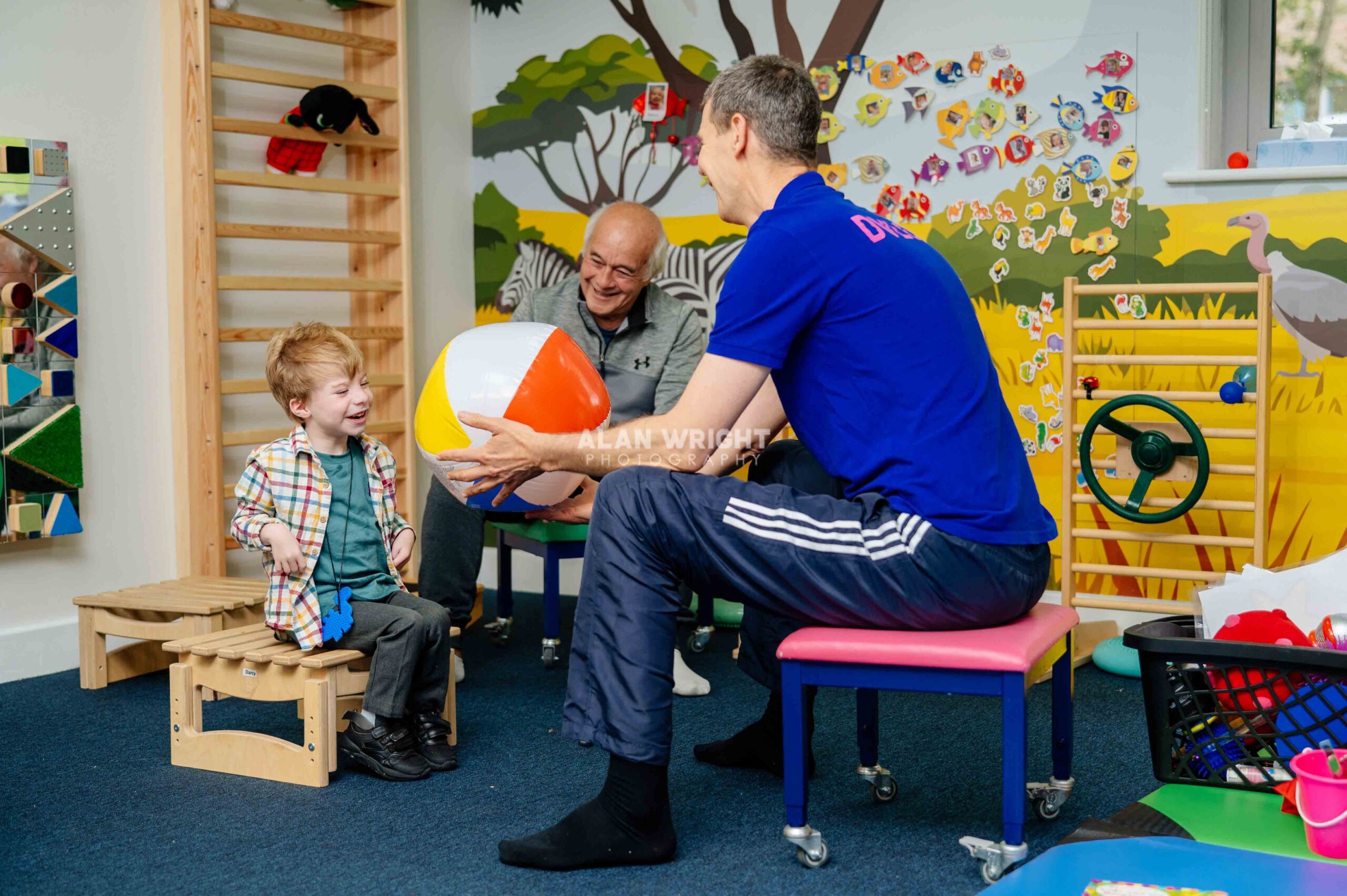
Istvan and grandad Malcolm engage Max through play (©AAH/Alan Wright)
HAPPY SIGNS
Malcolm and Veronica Peppiatt of Horsham, both former teachers, have come to rely on the charity to help care for their five-year-old grandson, Max.
Max has Bainbridge Ropers syndrome, another rare genetic condition caused by mutations in the ASXL3 gene, with only around 200 cases identified globally. Max is non-verbal and may never be able to speak properly, while low muscle tone (hypotonia) impairs him physically.
Veronica, a governor at St John’s Catholic Primary School, Horsham, heard about the DVLCC through a parent governor, who happened to also be a speech and language therapist. Max has since attended physiotherapy sessions for two years. Now of school age, he also attends Queen Elizabeth II Silver Jubilee School in Horsham, while continuing to visit the DVLCC once a week, where he has shown signs of improvement.
Veronica said: ‘Both of Max’s parents work full time, so we rotate with his paternal grandparents to look after him after school, and take him to the DVLCC every Monday after lunch. We were concerned about how Max would fare at school, but QEII is wonderful and he enjoys it. He always starts moving his limbs when the Minibus picks him up – a sign he’s happy – and does the same thing when we arrive at the DVLCC.
‘Although communication is very difficult, we can gauge his mood by his body language and sounds, whether that’s groaning or laughing. If you change the TV channel – put Moana on instead of Encanto – he will let you know if he’s unhappy! However, one of the challenges we face is developing clear forms of communication, as he’s reaching an age when he’s starting to become frustrated in certain situations. He has a computer tablet and although he cannot use screens independently, knows what he wants to select. So, we hope that could be a way to make further progress in future.
Max’s strength is improving through physiotherapy (©AAH/Alan Wright)
‘The main focus of his visits to the DVLCC is physiotherapy. Max follows the same routine each week, so the therapists can see if his core is strengthening. Physiotherapist Istvan Agoston always goes through the same things with him: they find the fish with Max’s name on, then read some books together. Max always wants to do this quickly, so that he can do the things he most enjoys – playing games, listening to sounds and watching the bubbles in the sensory room! Istvan is wonderful,
pushing Max ever so slightly beyond his comfort zone each week. Even if Max complains, Istvan calmly says, “I know Max, you’re doing great!” and this has helped him make progress with his mobility.’
With Max’s family offered only 40 minutes of physiotherapy on the NHS a month, the free one-hour weekly session provided by the charity makes a difference.
Malcolm said: ‘Max used to attend Little Barn Owls nursery, which he really enjoyed. One of the nursery rhymes that he used to sing was Wind the Bobbin Up. We noticed that Max tried to mimic the circular arm movements of the other children. It was a big step – perhaps his first clear voluntary movement. Now, we think he uses that same motion when he wants to listen to music. Max has also made significant progress with his feeding. He is fed through a tube four times a day and has always been oral averse, which we attribute partly to the traumatic ordeal of being fed through a nasogastric tube. Recently, his other grandparents successfully fed him Melty Puffs, which he can swallow once they’ve dissolved in his mouth. This feels like an important step.’
Max’s family have helped raise funds for the charity, with mum Holly raising £7,500 by running the London Marathon. To celebrate is 25th year, the charity hopes to provide support for an additional 25 children. To raise funds, the DVLCC holds an anniversary celebration at Sedgwick Park House, hosted by Clare Davison, and a Walk Together event in Haywards Heath (see advert, p61). The Ryan Canter Club will also be sponsoring a Picnic on the Square, featuring the Fred Woods Big Band, in Horsham (see p10) on 23 August.
Further information: For details about the DVLCC’s services, and upcoming fundraising events, please visit: www.dvlcc.org.uk
First published on 1st July 2026. Photos: Alan Wright Photography; Words: Ben Morris