

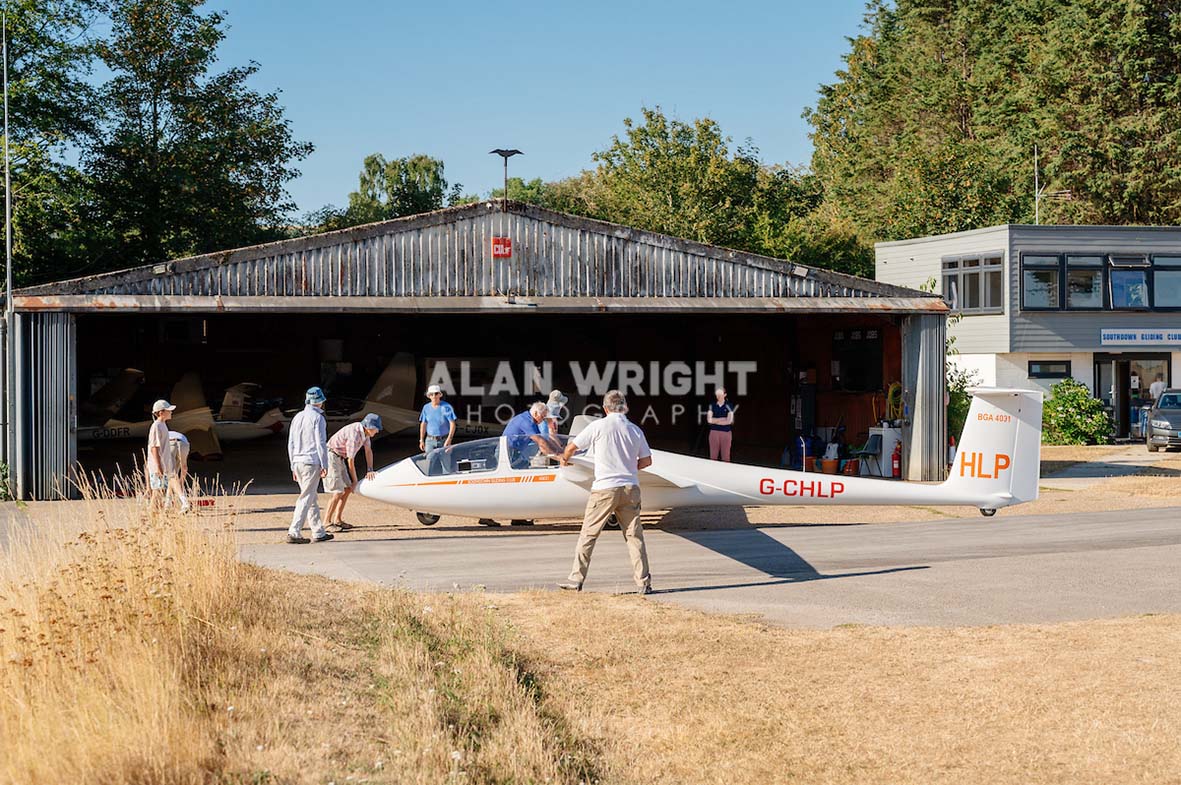
Southdown Gliding Club (©Alan Wright Photography)
For anyone harbouring dreams of flying, gliding is an appealing option. Of course, there are financial advantages – the costs involved in flying a powered aircraft are far greater, even before factoring in the price of aviation fuel. But for regulars at Southdown Gliding Club, gliding also provides a kind of weightless freedom that other forms of flying lack.
Pioneering pilots continue to push the boundaries of what’s possible too. In 2018, a concept glider called Perlan 2 soared 76,124 feet over the Patagonia mountains – higher than the mission altitude of Lockheed U-2 reconnaissance planes used by the US Air Force. Meanwhile, pilots perform increasingly incredible feats at the FAI World Glider Aerobatic Championships, such as a high-speed gyroscopic stall (known as The Lomcovak), where they face extreme gravitational forces as the stalled glider tumbles down through the sky. It’s fair to say though, that life at Southdown Gliding Club in Parham, near Storrington, is usually more sedate…
The club was originally founded in Firle in 1930, before splitting in two in the 70s (the other half being East Sussex Gliding Club) and moving to Parham. Today, it has a healthy membership, yet continues to attract newcomers through affordable introductory flights, which also come with a month’s free membership. The club’s website includes a quote by Neil Armstrong: “Gliders, sailplanes, they are wonderful flying machines. It’s the closest you can come to being a bird.”
There’s no shortage of people wanting to capture this feeling themselves. Simon Pettett first visited the club three years ago for an introductory flight and is now a solo pilot.
He said: ‘I spent over 30 years as a police officer and towards the end of my career was part of helicopter operations. I loved the experience and the camaraderie of the crew, and missed it after retirement. So, I came down for an introductory flight and enjoyed it. As it came with a month’s free membership, I returned to the club, as there’s a wonderful, social atmosphere. Some people just relax at the clubhouse, chatting, watching the gliders take off and offering advice to young fliers. I still work three days a week, so it wasn’t until last autumn that I reached a solo standard. I still learn something new every time I fly.’
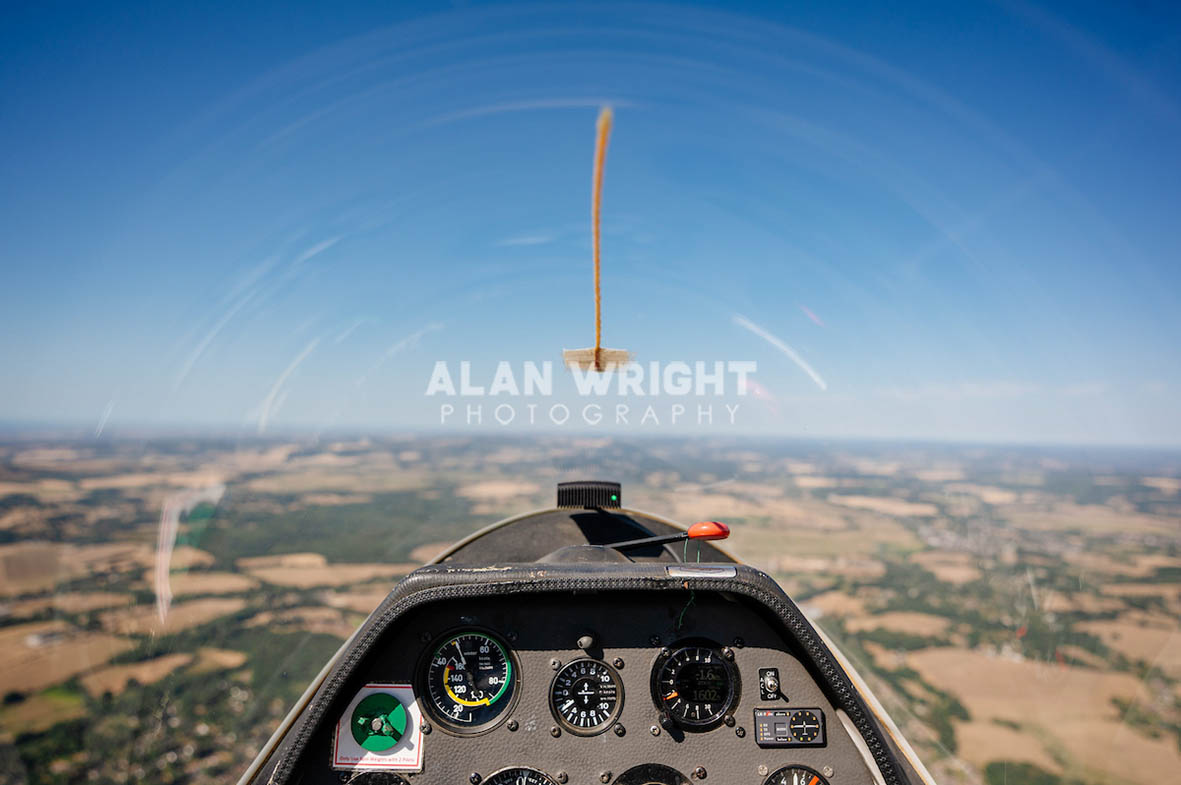
Taking flight about Parham (©Alan Wright Photography)
LOCAL LANDMARKS
It’s a thrill that AAH photographer Alan and editor Ben were able to experience themselves. If we were a little nervous about squeezing into a parachute, it was a relief to hear nobody had yet needed to deploy one at the club.
The club has purchased two new light aircrafts, used for launching gliders. As gliders don’t use an engine (although some do have one as a back-up) they are launched in two ways. One is via a winch, with a cable pulling the glider along the ground. When it has attained enough speed, the glider takes off it and the cable is detached. The other options is an aero-tow, where gliders are attached to a light-aircraft by a cable, which is detached at a safe height.
As we bounce across the grass in the tight cockpit of the two-man glider (piloted by an experienced instructor), it feels like being in a go-kart. Flying the powered tow-plane ahead of us is Steve Williams, who has held many posts at the club, including Deputy Chief Flying Instructor. He also serves as Club President and often pilots the tow-planes. Today, he is flying one of the club’s new planes, built by EuroFox Aviation, with striking black and yellow livery. ‘The EuroFox planes go up much quicker than our older Piper Pawnees,’ says Steve. ‘It means we can tow one glider, release it, and be back on the ground within 10 minutes. The engines are quieter too, which is good for our neighbours!’
It’s not long before we are soaring at 2,000ft. Gliders usually circulate around 3,000ft, but we won’t be travelling far today. Still, it’s high enough to pick out many local landmarks – Parham House, Amberley Wildbrooks, River Arun and Rock Quarry at Washington – as we head south, towards the coast. Gliders are designed to slowly descend, but can use thermal uplifts – prevalent along the Downs – to gain altitude swiftly. I’m told one club member recently flew 650km, while a junior stayed in the air for five hours by using uplifts to gain height, while always staying in sight of Parham. After the long, dry summer (this was August), the landscape is a kaleidoscope of browns and yellows, which offers its own bleak beauty. Soon, we’re heading home, descending in circular motions until we straighten up to approach the landing strip beyond a row of trees. The landing is smooth and once again we’re bouncing across the brown turf.
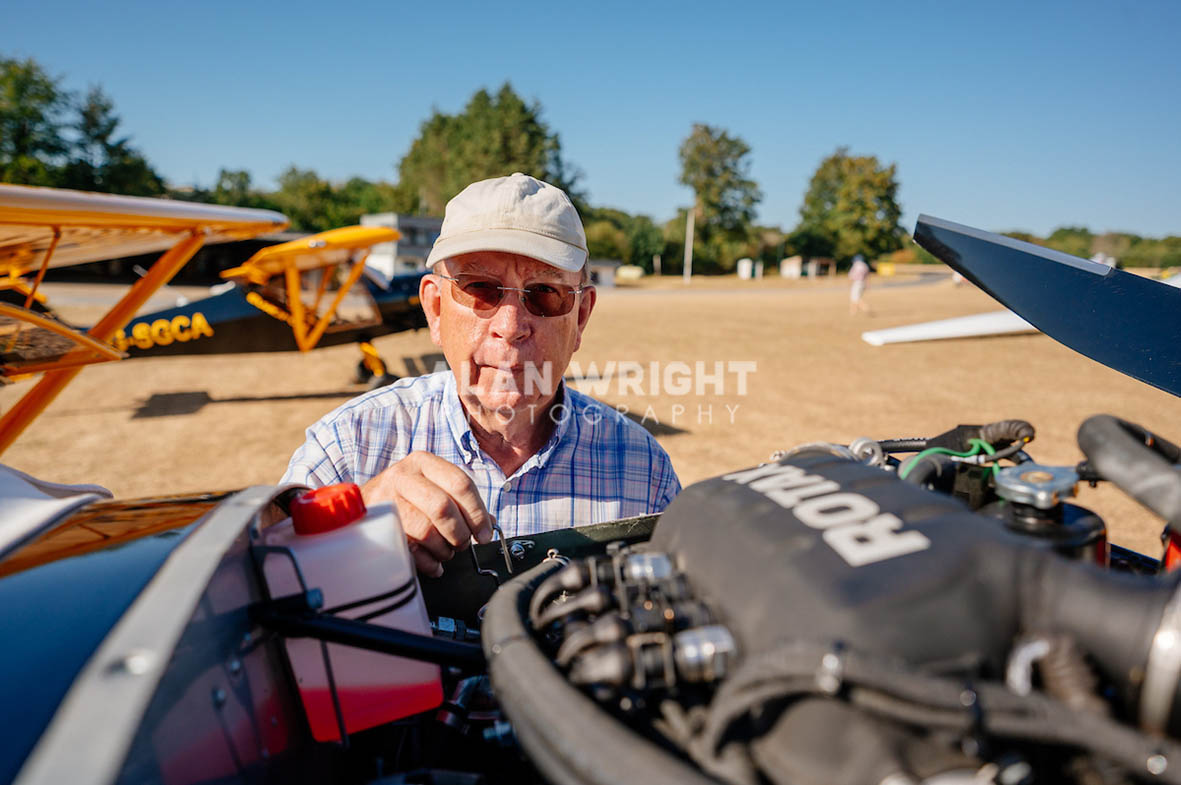
Steve Williams, Club President (©Alan Wright Photography)
JUNIOR PILOTS
There are many others waiting for their turn to fly, including several youngsters. The club is proud of its junior section and offers affordable options to encourage young people to develop their flying skills.
Felix Carter, 14, is one of those currently learning to fly. He said: ‘I’ve always had an interest in planes and it’s my dream to become an airline pilot. It’s not something that anyone in my family does – it’s just in my DNA. Flying schools for light aircraft are expensive. but then I found out about gliding, which costs less, and my mum said I could try it. I was on a waiting list for a few months, but have now been up in a glider eight times.
‘It has only enhanced my passion for flying. From my very first lesson, the instructors let me take control of the glider and get a feel for turning. I now take control for most of the flight and even landings. There’s a lot to learn, as you have to make sure your speed and altitude are right when you’re approaching the airfield. My next step is to learn how to take-off with an aero-tow, so I’ve been coming down during the holidays to get more flying time before I go back to school.’
Daisy Richie-Butler, 15, is another young flyer. Daisy (pictured below) is following in the footsteps on her brother Ted, who has attained his Sailplane Pilot Licence (SPL). Daisy said: ‘I started on this journey two years ago and have since had 75 flights. I need to perfect landings, as well as stalling and controlling spiral dives, before I can attain a solo certificate and work towards my SPL. You have to practise in different conditions to show you can adapt to various weather conditions and wind directions too, and also master take-offs with an aero-tow. I’m gaining confidence every time and hope to be ready for a solo flight soon.
‘It’s great experience for me, as my dream is to become a commercial pilot or maybe pursue a career in the military. It’s also fun just being up in the clouds and catching a thermal. If the conditions are right, you can glide for ages. When the sky is blue with few clouds around, you need to work harder, searching for landscapes that might generate additional lift, so there’s lots to think about when you’re in the air.’
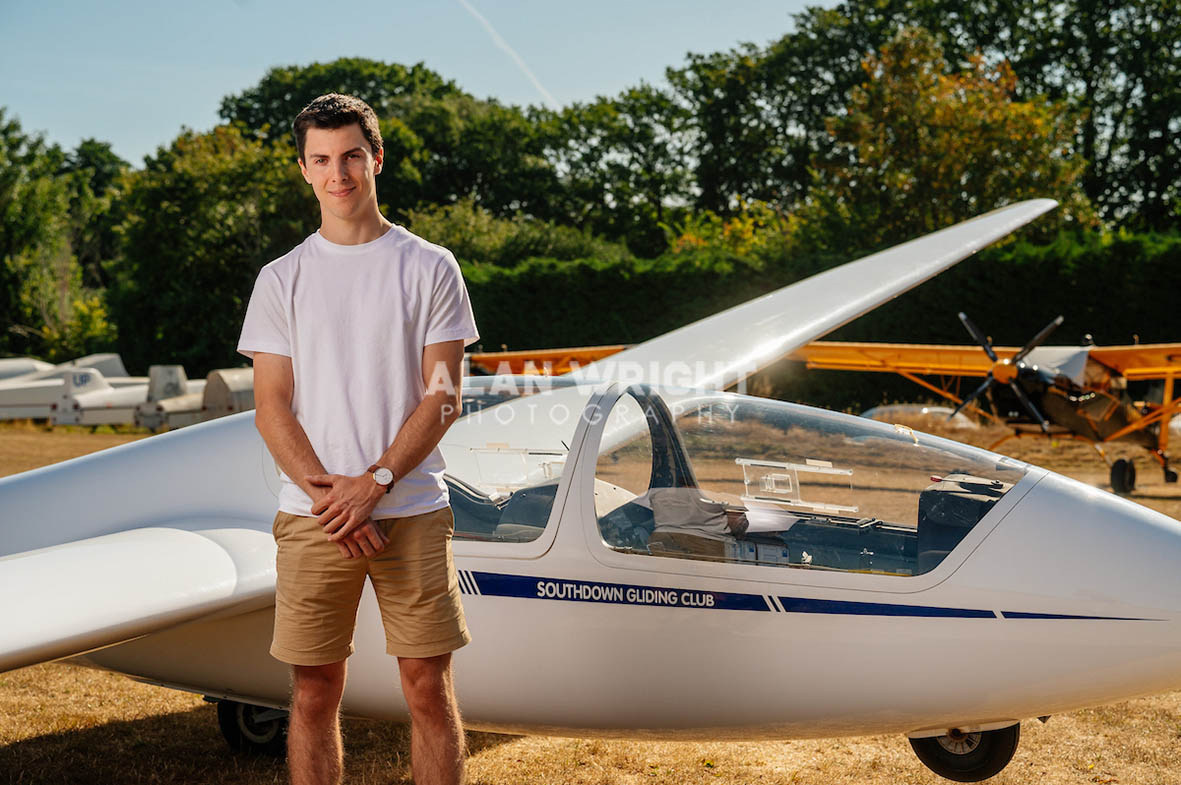
Harry Rushton is joining the RAF (©Alan Wright Photography)
HIGH ACHIEVERS
To help with training, pilots keep a logbook, with information relating to speed, altitude, distance and wind direction. Apps such as Glide and Seek are also widely used as a way of tracking flights. Some of the club’s most talented fliers have also made their mark on the international scene. Sebastien Van Der Stichele started his flying journey at Southdown. Now 21, he finished 6th at the FAI Junior World Gliding Championships in August. As well as pursuing aviation careers, people have other reasons for flying. Harry Rushton, 24, from Uckfield, is gaining experience before he joins the RAF.
Harry said: ‘Once I have completed my initial officer training, I will start elementary flight training at the RAF. I felt it would be useful to have some flying experience under my belt. As a beginner, I’m taking flights with a club instructor. However, they’ve given me hands-on experience, while still being there to correct me. Although they have a simulator too, I feel it’s better to gain experience in the air and get used to flying before committing to a career in the RAF.’
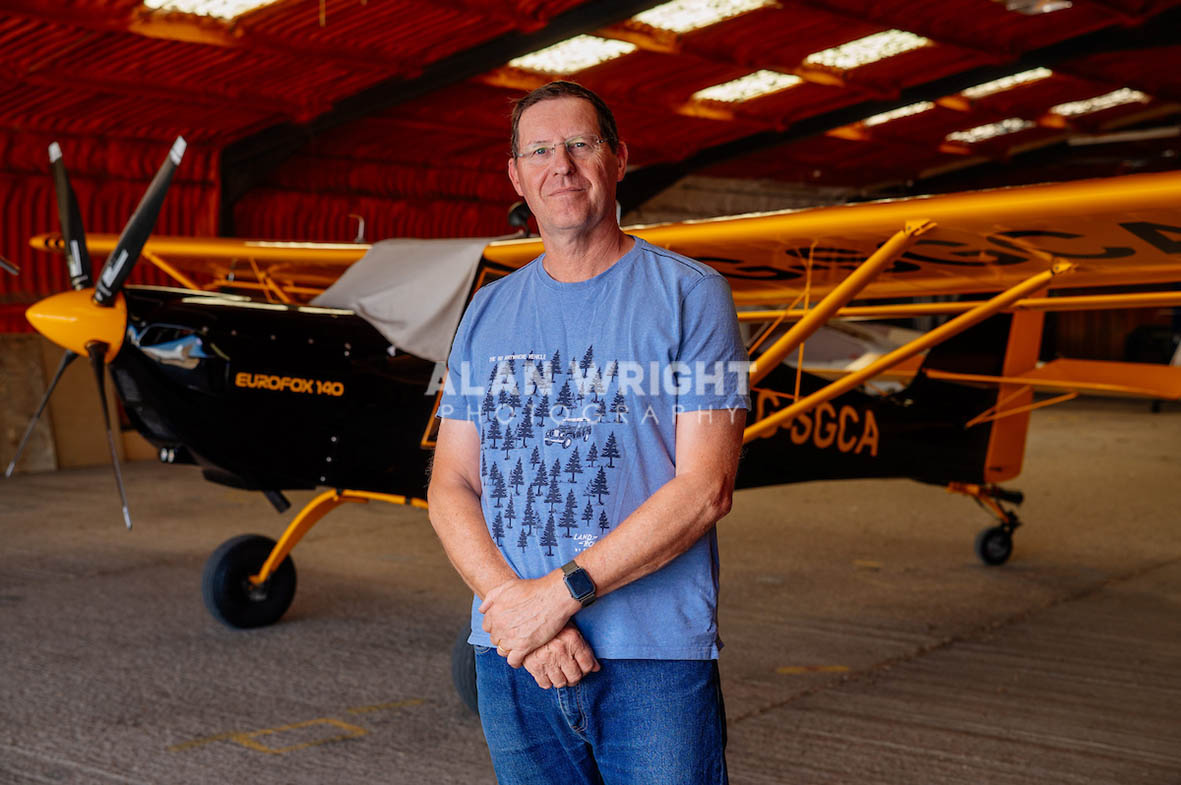
Will Greenwood, Chairman (©Alan Wright Photography)
THRIVING CLUB
The club offers flexibility when it comes to learning to fly, with some people able to commit to weekly flights – which means they could potentially fly solo after six to nine months – while others take longer by flying less frequently. After becoming a solo pilot, you can then try to gain a full SPL. The club has its own planes which can be used by members, while others choose to invest in their own glider. It’s common for members to co-own, with groups of four or even eight people sometimes sharing a sailplane. The club has invested in new tow-planes and hopes to update its gliders soon too.
Will Greenwood, who has been Chair since March, said: ‘The club is thriving, as we’re fortunate to own the field (having purchased the land from the Parham Estate in 2009). We also have a large clubhouse, hangers, and our own tow-planes and gliders. We’ve managed to maintain a healthy membership of around 400, with perhaps 150 flying members, while also developing a fantastic junior programme. However, we’re always looking to improve. We have three club-owned two-seater gliders and two solo gliders, and are looking to replace one of the two-seaters soon. We also plan to utilise the other side of the field to give us wider scope for landings. That would help on busy days, when many people are eager to take to experience the thrills gliding.’
Further information: Southdown Gliding Club, Parham Airfield, Pulborough Road, Cootham, RH20 4HP. Visit the website at www.southdowngliding.co.uk
First published on 1 October 2026. Words by Ben Morris / Photos by Alan Wright.