

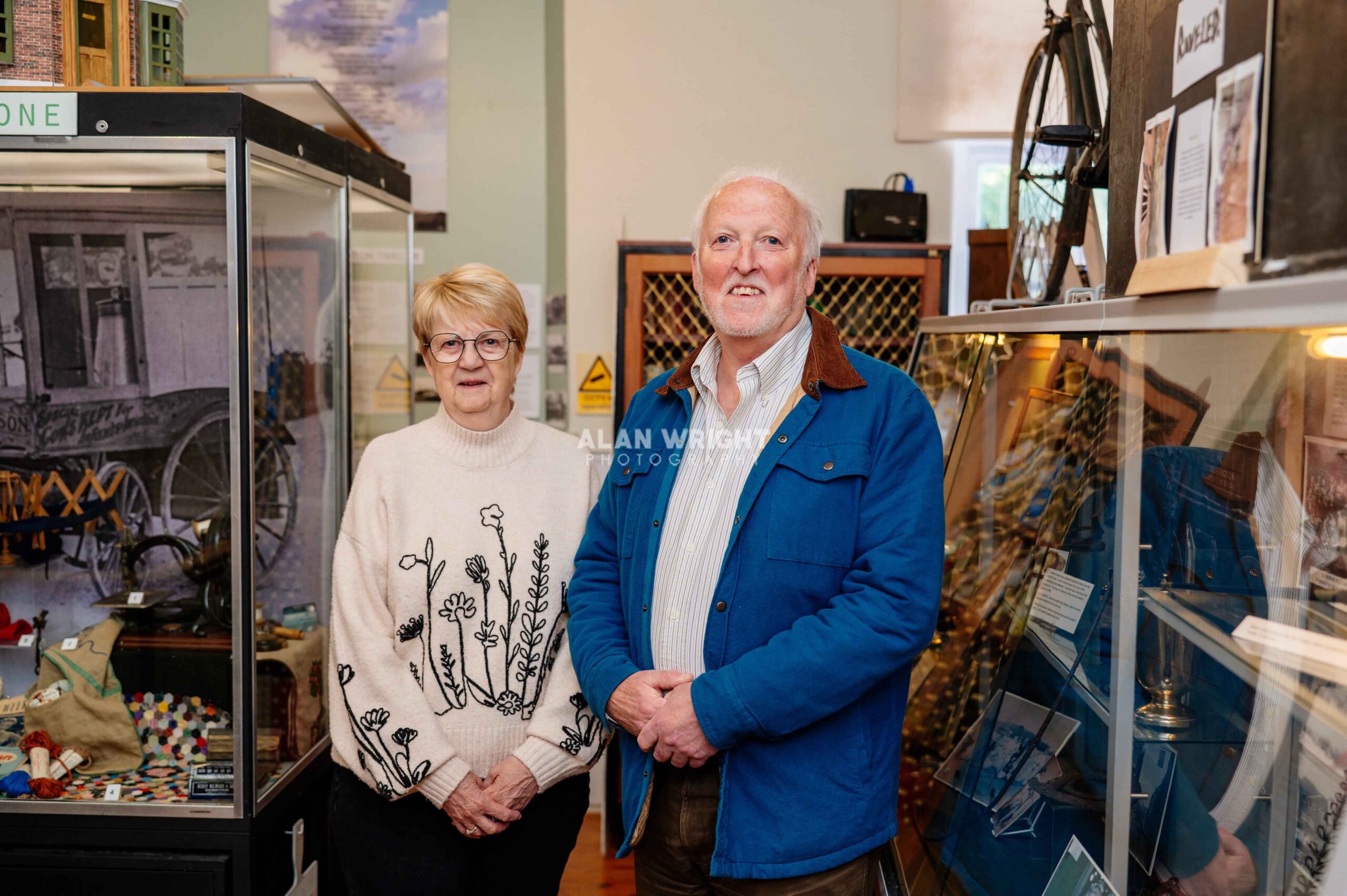
Volunteers Steve Whyley and Mary Mitchell (©AAH/Alan Wright Photography)
Storrington & District Museum, located in the Old School building on School Lane, has been awarded the title of ‘Community Asset’ by Horsham District Council. AAH visited the museum to find out more…
THEN & NOW
To celebrate its 25th anniversary last year, The Storrington and District Museum produced a book, called Storrington Then & Now. Inspired by a 1977 book by Florence Greenfield, it offers a photographic record of the village, comparing pictures taken long ago (some dating to the 1860s) with new images of the same locations.
Today, many people living in other parts of the District may associate Storrington with queues of traffic. An estimated 500,000 vehicles pass through the village every month, ensuring an almost constant flow of cars on West Street as motorists navigate between the A27 to the south and the A24 at Washington to the north. It’s for this reason that members of Storrington Camera Club went out at the break of dawn to take photos of traffic-free streets for the book.
Despite the queues that form through summer, the pages of Storrington Then & Now show that many of the village’s historic and architecturally interesting buildings have survived, even if the businesses they house have changed with time. Even on West Street, the village continues to host a variety of independent shops, cafés, pubs and restaurants, all well served by Waitrose in Old Mill Square.
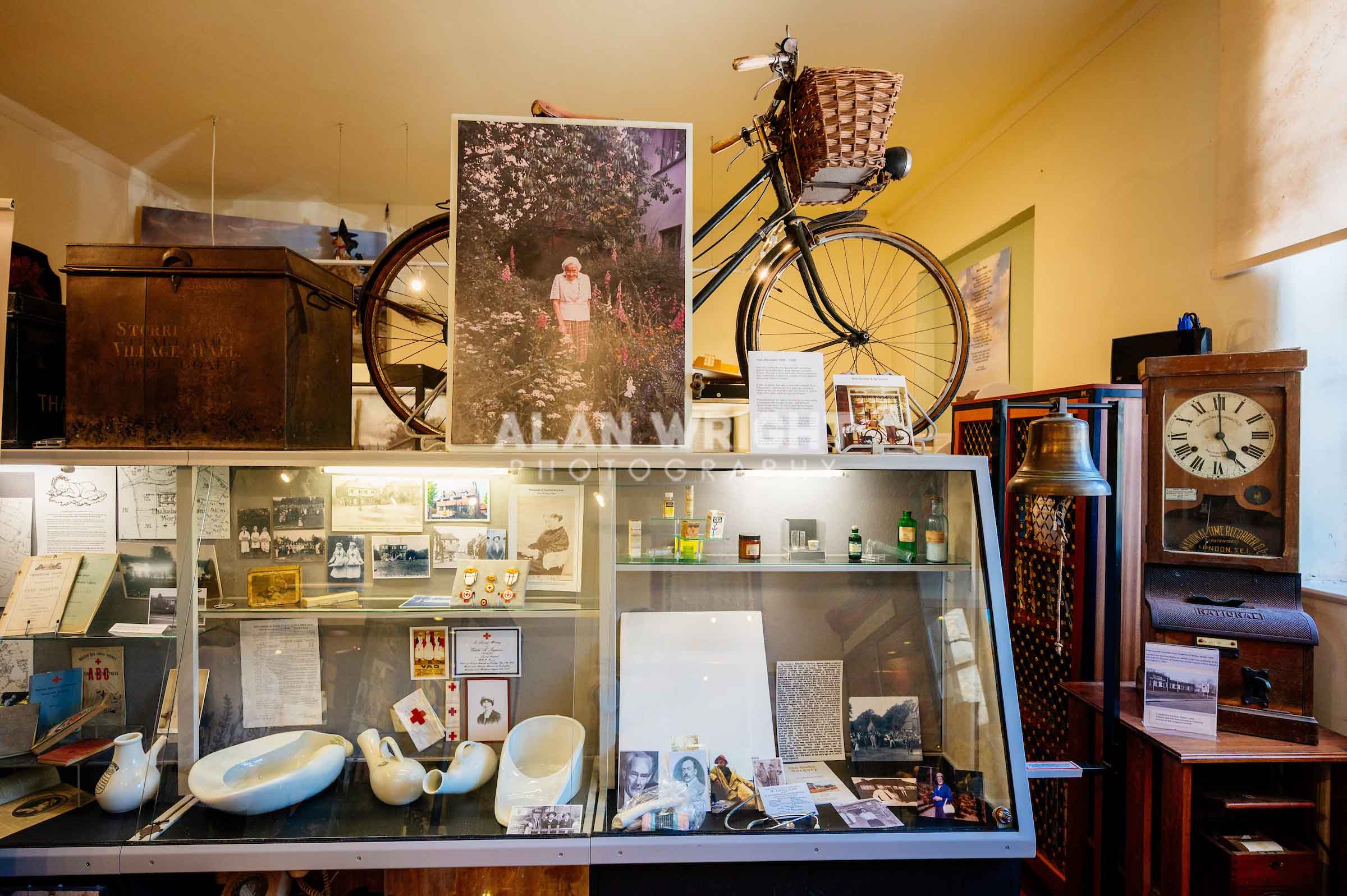
The Museum has many exhibits celebrating village life (©AAH/Alan Wright Photography)
Although it has sadly been empty for three years, The White Horse Inn, originally build circa 1500, has remained largely unchanged since the 1890s. The front of The Moon has barely altered either, although stables to the rear are now a beer garden. The Victorian façade of The Anchor (which has enjoyed a revival since re-opening in 2025) has also changed very little.
However, it’s along Church Street that Storrington retains much its history. St Mary’s Church stands on a mound that has been home to a chapel for over 1,000 years. It is renowned for its beautiful graveyard, which includes Commonwealth War Graves. Nearby, the Gothic-styled St Joseph’s Abbey was once a rectory and later a Dominican convent. Today, it has been converted into luxury apartments, yet retains its original charm. Another site of historical interest is Our Lady of England Priory. Founded by Roman Catholic priests exiled from France in the early 1880s, it is now licensed to the Chemin Neuf Community, with a vineyard in the grounds.
Along School Lane, in an 18th century building, you’ll find the beautiful Old School. It hasn’t been used as a school since the 1960s, but as it’s owned by the Hooper Downer Educational Trust, continues to be used by groups serving the community. Part of the building is rented to Storrington and District Museum, a registered charity which opened to mark the millennium. The museum plays a pivotal role in preserving and sharing the heritage, culture and identity of Storrington, as well as surrounding villages including Ashington, Sullington, Thakeham, Washington and West Chiltington. There are permanent exhibitions of artefacts, books, maps and other documents, including census records, local archaeology, articles from local churches and items relating to the two world wars.
Some exhibits relate to well-known personalities connected to the area, including Cecily Mary Barker (who wrote The Flower Fairies books), Colonel Ravenscroft (the last private owner of The Abbey, who is immortalised in Hugh de Selincourt’s classic book, The Cricket Match), Cardinal Cormac Murphy-O’Connor (a former Archbishop of Westminster who resided in the village) and John Galsworthy (author of The Forsyte Saga, who lived on Church Street in later life).
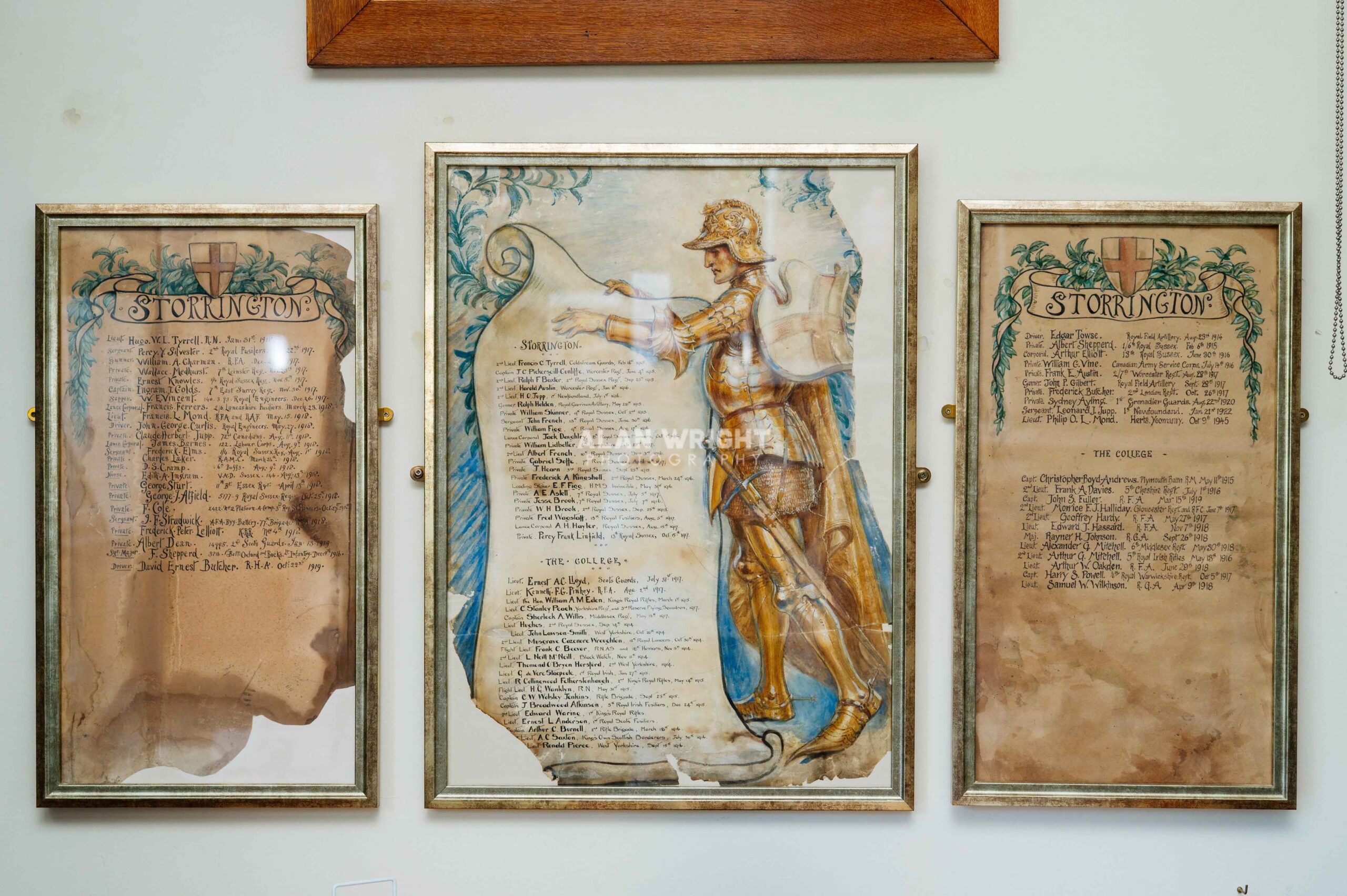
Rolls of Honour (©AAH/Alan Wright Photography)
ROLL OF HONOUR
Perhaps the museum’s most important artefacts are the Rolls of Honour, which feature a painted representation of St George in armour and the hand-written names of local people (and students of the College in Church Street) who served in the Great War. The first of these panels was originally installed on the wall of the Assembly Rooms, next to the White Horse Hotel, in 1917. Two further panels were added in 1919, but they were all later lost, only to be unearthed years later in storage at Horsham Museum.
In 2014, community volunteers led by Stuart Duncan were awarded a grant by the Heritage Lottery Fund to conserve two of Storrington’s Rolls of Honour, while a third panel (which wasn’t found) was recreated by local artist Dennis Lascelles.
Much of the meticulous research was carried out by dedicated volunteers. The museum is staffed entirely by volunteers, who help as stewards or in fundraising or administrative roles. Steve Whyley joined the team three years ago, using his experience as a commercial director to attract new funding…
Steve said: ‘When I retired, I wanted to be involved in the community and became a museum trustee. Although we have fantastic volunteers looking after artefacts and assisting people with local history enquiries, I felt more could be done to raise funds. Although our landlords are supportive, half of the museum’s expenditure is absorbed by rent alone.
‘So, we have tried to generate new income streams, compiling the book and creating a calendar that is well supported by local businesses. We also hold quiz nights, music nights and historical walks in summer, as well as hosting an annual art exhibition. Our monthly talks with specialist speakers are popular too, and we include details of all events, along with museum news, in a newsletter, Times Past, distributed to members.
‘Another important project is the pain-staking digitisation of the museum’s archives. We have detailed some 10,000 artefacts and documents, which we hope will eventually form part an a commercially available database. This will not only help us record what we have, but assist anyone researching local history. We still need to secure additional funding for this project, which is always challenging. Membership income supports only 8% of operating costs, with the remaining 92% raised through grants, donations, sponsorship and fundraising activities.’
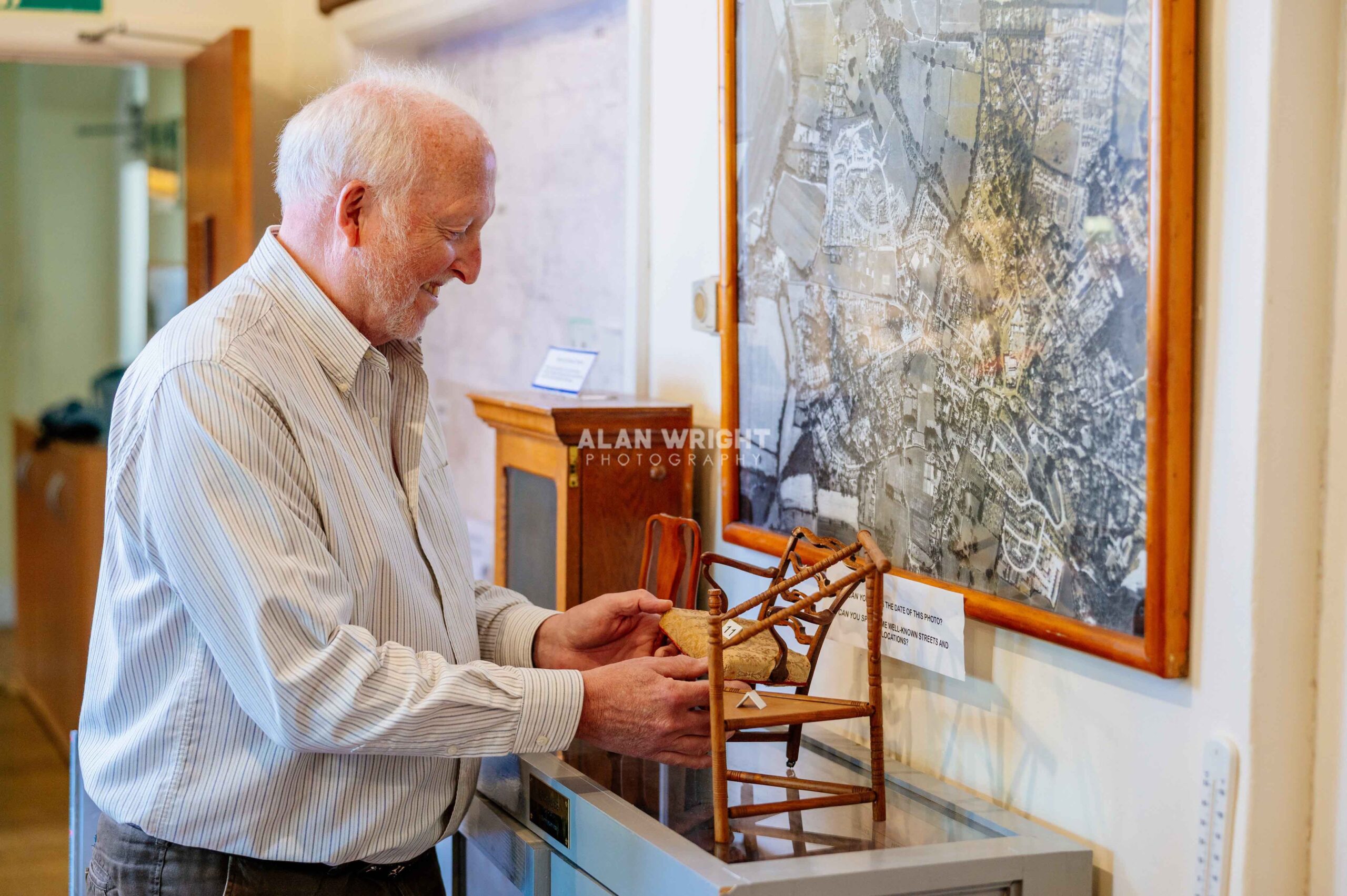
Steve Whyley organises a collection of miniature chairs (©AAH/Alan Wright Photography)
STORK VILLAGE
The museum is open on Wednesdays and Saturdays (10am – 4pm). Newcomers to the village often visit to learn about Storrington’s history, while volunteers also welcome overseas visitors and walking groups with an interest in the area’s history. Trustees and volunteers occasionally lead local tours or school groups too. Village events, such as May’s White Stork and Nature Festival, offer further opportunities to engage with the public. This annual festival celebrates nature, but particularly the return of white storks from their migratory journey.
Mary Mitchell moved to Storrington from Horsham four years ago. Volunteering has given her an opportunity to learn more about her new home and make friends. For Mary, the return of the storks at nearby Knepp makes this an exciting time for Storrington…
‘In the Domesday book of 1086, the village is listed as ‘Estorchestone’, meaning a place well-known for storks. Even the river that flows through the village (the Stor) is named after them, so everything about Storrington’s history relates to storks. So, to now see them flying overhead for the first time in 600 years is very exciting.
‘Last year, the White Stork Project became part of the European Stork Villages Network (ESVN) and Storrington is the UK’s only official Stork Village. The Stork Festival was organised to celebrate this, bringing the whole community together. We are producing a colouring competition for local schools, introducing young people to some of the village’s historical sites, and no doubt storks will feature in this too. Such events help us spread the word about what we do, as there are still people who have lived in Storrington for years and don’t know the museum exists!’
Further information: Future talks can be found online at: www.storringtonmuseum.com
First published on 2 August 2026. Photos: Alan Wright Photography/Words: Ben Morris