
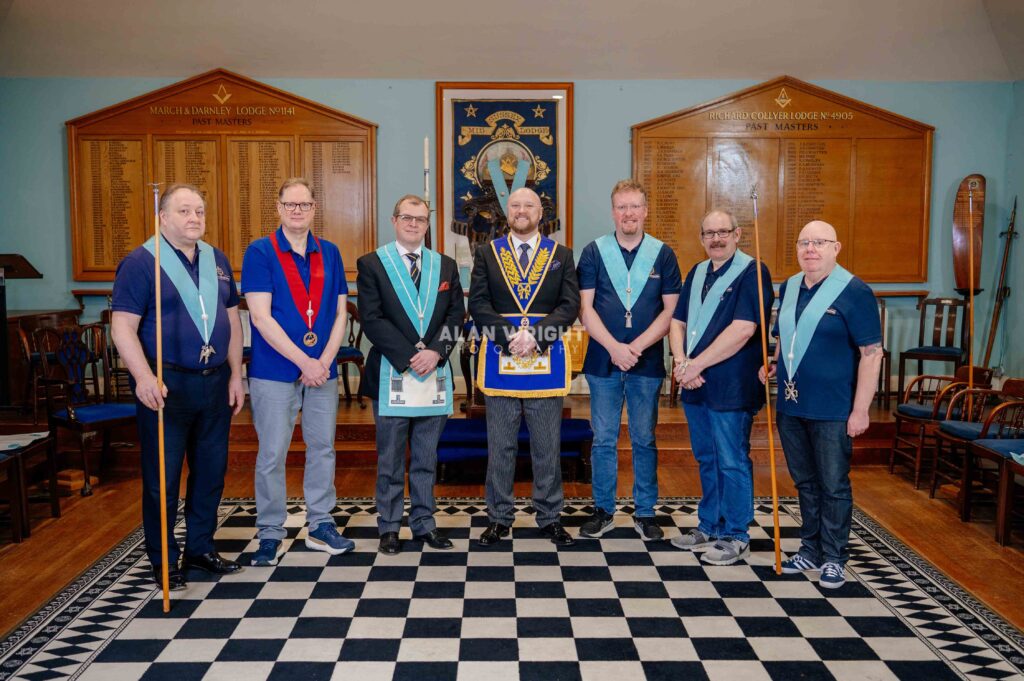
Horsham Freemasons at the Masonic Lodge (©AAH/Alan Wright)
Freemasons recently held an Open Day at the Normandy Centre in Denne Road, Horsham.
Members from various Lodges were on hand to talk about Freemasonry, what it means to be a mason, and showcase its community work. Despite a reputation for secrecy, AAH received a warm welcome from masons Adrian Butcher, Neil Toms and David Fairhurst, as well as Ryan Smith, Chair of the North Group of Sussex Freemasons…
GOING GLOBAL
Explaining the structure of Freemasonry is a job in itself, as the organisation has millions of members. In America alone, there are about 13,000 masonic lodges – the name given to the venues where members meet. In the UK, where Freemasonry originated, there are about 7,000 lodges. The United Grand Lodge of England (UGLE) in Covent Garden governs them all, with lodges organised into Provinces. One of these is Sussex Freemasons, which has about 150 lodges, with its Provincial Grand Lodge in Brighton…
Ryan: Sussex Freemasons has recently been re-organised into four geographical areas: North, East, South and West. In the North group, there are eight Masonic Centres, in Crawley, East Grinstead, Haywards Heath, Hurstpierpoint, Lewes, Uckfield, Wisborough Green and Horsham. Each Masonic Centre can be home to several Lodges and Royal Arch Chapters. Between the eight Centres in Sussex North, there are 33 Lodges and 11 Royal Arch Chapters.
Adrian: I’m a mason in Richard Collyer Lodge, one of six Lodges that meets at the Normandy Centre. The others are March and Darnley, The Causeway, Carfax, Stane Street and Aviation & Combined Services. Lodges vary in size, with the smallest Lodge in Horsham having about 20 masons and the largest around 40. There are 24 masons in Richard Collyer Lodge. However, most of us know masons in the other Lodges and we can visit them too, which creates a sense of brotherhood.
Adrian: Freemasonry Lodges are formed at different times and for different reasons. Richard Collyer Lodge was founded in 1927, predominantly for former pupils and staff of Collyer’s Grammar School. Members still wear a replica of the tie worn by pupils prior to its transition to a Sixth Form College. I’m one of several members that didn’t attend Collyer’s, but it was still the Lodge I was best suited to. The Lodge maintains links to Collyer’s, supporting various college events and awards nights.
Neil: I became a mason in 2020. My father and grandfather were masons, so I grew up around it, attending my first Ladies Festival Weekend (a social event where wives, partners and children are welcome) when I was six. My father’s Mother Lodge (where a mason is initiated) was Nile Valley Lodge, established by former RAF servicemen in Cairo. So, as a commercial pilot, it was only natural that of all the Lodges in Horsham, I joined Aviation & Combined Services.
David: Special interest Lodges have been formed to bring together those with a shared occupation or passion. In Sussex, these include a Railway Lodge (Haywards Heath), Motorcycling Lodge (Worthing), Football Lodge (Brighton), Classic Motoring Lodge (Worthing) and even a Trout and Salmon Fishing Lodge (Burwash).
Adrian: As well as Lodges and Chapters, there are many other high-level Masonic orders, with the best-known including Knights Templar and The Ancient and Accepted Rite, known as Rose Croix. These are for Master Masons who have been exalted into the Holy Royal Arch Chapter.
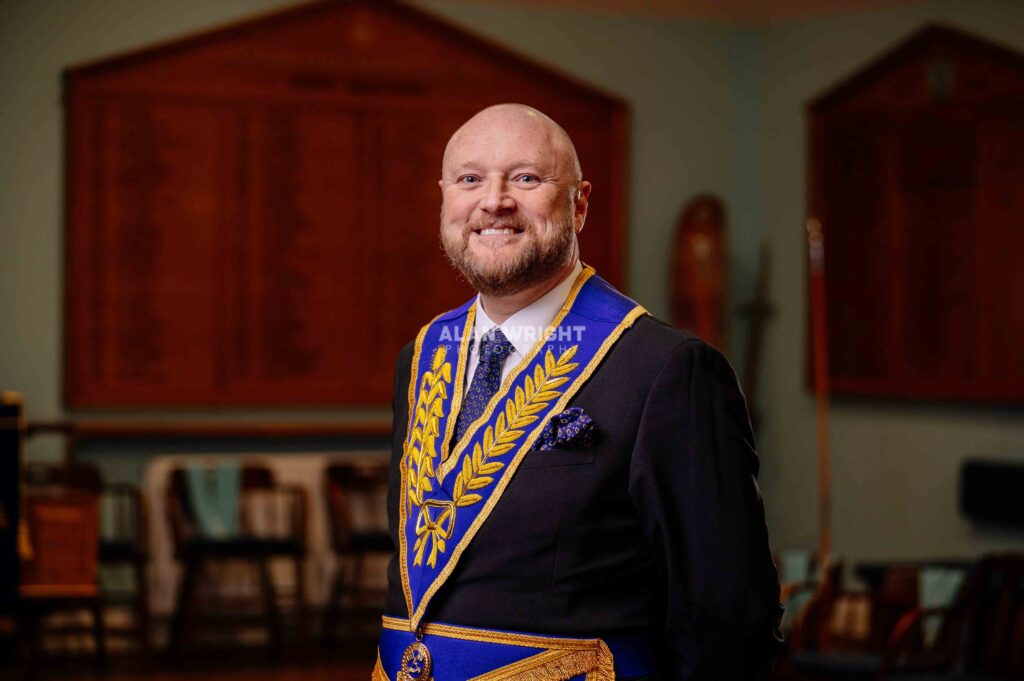
Ryan Smith, Chairman of the North Group of Sussex Freemasons (©AAH/Alan Wright)
BEING A MASON
Freemasonry traces its roots to medieval guilds of operative stonemasons, but you don’t have to be a stonemason to become a Freemason. The modern organisation is more fraternal and requires no professional construction or masonry skills, although it utilises the tools and language of masonry to teach moral and ethical lessons. To join, you need to be 18, believe in a Supreme Being, possess good moral character, and be a law-abiding person of good reputation. Lodges are male-only, although The Order of Women Freemasons has a handful of Lodges in the county, albeit none in the Horsham District….
Ryan: You shouldn’t look to join for financial gain; you should join for self-development, to build friendships, and to perform a community service. I joined 24 years ago and am an example of somebody who has improved his life through Masonry. We encourage Freemasons to be better members of society. When facing everyday scenarios, I ask myself, “What would a Freemason do?” We have a generation of men that are slightly lost and lacking a moral compass. We can provide these things for them.
Adrian: When it comes to joining, enquiries can be made via the Sussex Freemasons website. I joined in 1992, after approaching a colleague who was wearing a stone ring with the masonic stone and compass symbol. The good thing about Freemasonry is that from the moment you join, you have a room full of friends.
David: We used to say that if you want to be a Freemason, ask one! Nowadays, every Provincial Grand Lodge has a website where you can apply. One of the first questions I would ask at an interview is, “Would your partner support you joining?” It would be a red flag if somebody wanted to join without such support, as Freemasonry takes up a lot of time. If they fulfil the criteria, we connect them to a Lodge depending on their locality, age and interests, before introducing them to the Membership Officer of the Lodge.
Ryan: There are four steps in “Pure Antient Freemasonry”. You are introduced as an Entered Apprentice (the First Degree), before becoming a Fellow Craft (Second Degree), and a Master Mason (Third Degree). After the three degrees comes the Holy Royal Arch (Fourth Step). All freemasons are known as Brothers or Brethren, becoming a Companion after the Fourth Step. With each step, there is a ceremony, with the Fourth Step ceremony held in a Chapter, not a Lodge. We encourage people to take that journey through each step, but it’s a personal choice and perhaps half of all masons become Royal Arch Masons.
Neil: We have various regalia, including aprons and collars, which depict our standing within a Lodge. An Entered Apprentice wears a white apron, while a Fellow Craft mason has a light blue apron and collar, and Master Masons wear darker blue. Some masons have special distinctions that come with appointed roles, such as staffs, that are carried by Deacons and Stewards, while the Worshipful Master (Master of the Lodge) wears a collar and apron with more lavish decoration.
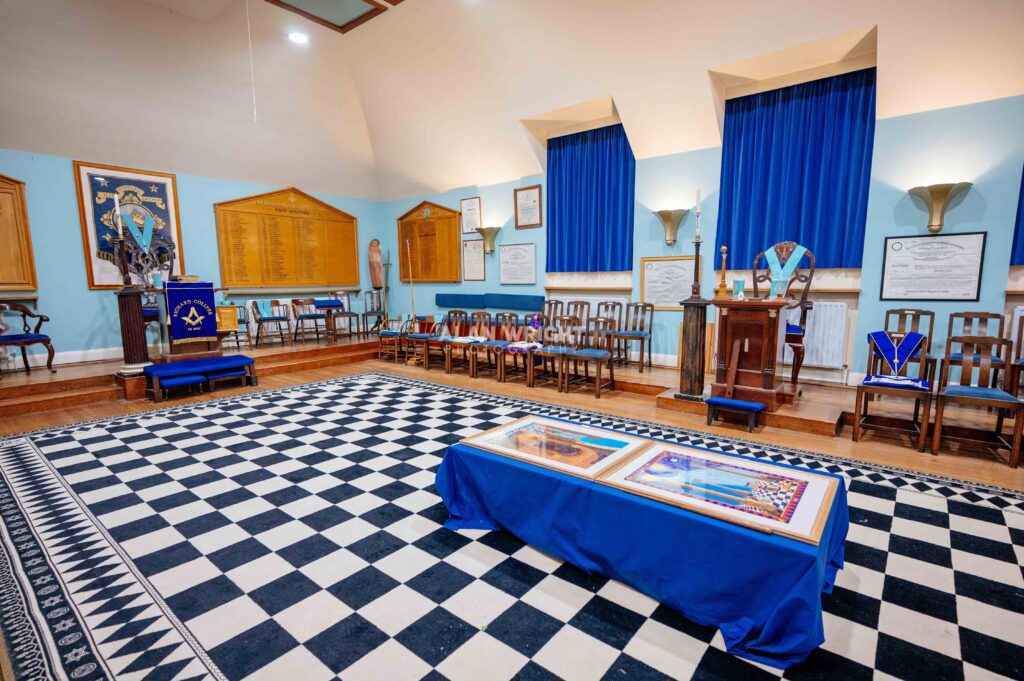
The Masonic Lodge at The Normandy Centre (©AAH/Alan Wright)
THE MEETINGS
Initiation ceremonies can resemble a symbolic play and mark a new member’s passage “from darkness to light”. Further ceremonies are held as a mason progresses to the next stage towards becoming a Master Mason. The secretive rituals of the ceremonies have made Freemasonry a favourite topic of conspiracy theorists…
Adrian: A Lodge will typically meet between four to six times a year. Meetings include formal business and ceremonies and are usually followed by a meal. There is a little bit of amateur dramatics involved in ceremonies, but I enjoy the camaraderie it creates. Lodges have slightly different rituals and we use one called “Sussex Working”. It’s interesting visiting other Lodges to see how their ceremonies differ.
Neil: As well as regular meetings, we have Lodges of Instruction (LOI) – informal gatherings that provide opportunities to rehearse before a ceremony. An initiated mason is supposed to learn the text of the “Obligation” by heart, so it helps to practice beforehand with masonry brothers. The morality of the ceremonies is based around the building of King Solomon’s Temple 3,000 years ago, with the temple symbolising the moral and spiritual development of a mason’s character, and I personally enjoy these ancient traditions. You feel part of something that has been passed down for centuries.
David: A candidate enters the initiation blindfolded or “hoodwinked”, representing their state of darkness. The blindfold is removed only once you have made an oath not to share the secrets of Freemasonry. That first revelation – symbolising the restoration of light – is significant. You hear stories of people joining a Lodge and upon having the blindfold removed, seeing the faces of people they know, but never knew were freemasons.
Neil: The secretive elements of Freemasonry inspire interest from conspiracy theorists. The Freemasons is not a secret society, but it a society with secrets. There is particular fascination with orders such as Knights Templar and the Order of the Secret Monitor, which you can join only once you have completed the journey to Master Mason.
David: It seems that conspiracy theories are more prevalent in the age of social media. Everyone seems to have an opinion on freemasonry, whether these opinions are founded on fact, fiction or complete fantasy. I made a promise not to reveal the secrets of the Freemasons, but if you really wanted to, there’s little you couldn’t find out on the internet. However, I would recommend that anyone interested in becoming a mason avoids the temptation, as preserving the mystery enhances the experience of the initiation ceremony.
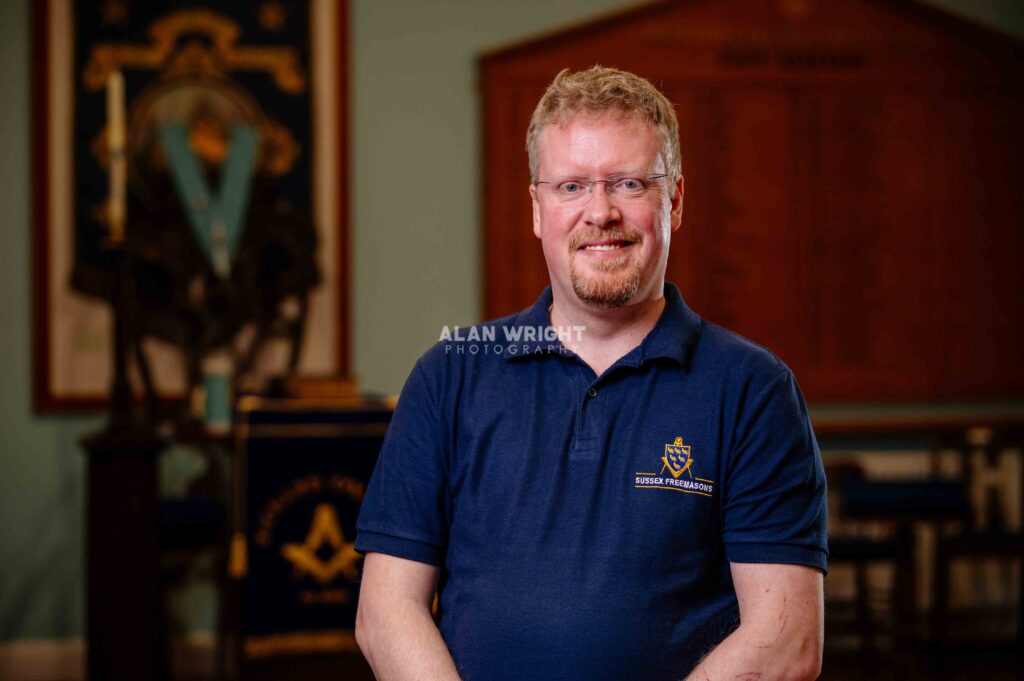
Pilot Neil Toms of Aviation and Combined Services Lodge (©AAH/Alan Wright)
SOCIAL SIDE
Outside of Lodges, mason meet for meals and social events. They carry out charitable work too, raise money for community projects and volunteer at local organisations…
Adrian: Our social committee organises activities from curry nights to family get-togethers. The Freemasons is also one of the UK’s largest charitable organisations, with contributions mostly coming from members. Aviation and Combined Services Lodge recently made a donation to Horsham Matters’ Connecting Café. Our members have also volunteered at Amberley Museum and Phoenix Stroke Club, and funded a kit for Broadbridge Heath FC’s Pan-Disability team.
Neil: We also operate The Ashlar Club, a Light Blue Club which organises social events for newer members and their families in North Sussex. We visit pubs and breweries, and are soon going to the United Grand Lodge in Covent Garden.
David: We do need to attract more people of working age, as the age profile has crept up. My father joined in his early 30s, which was the norm at the time. To properly represent and serve the community, Lodges should be represented by masons of all ages, from 18 to 80 and beyond.
Adrian: I believe Freemasonry will experience a Renaissance, as many people have become socially detached. Many of us work from home, which restricts social contact, while young adults have become overly reliant on phones. So, we’re starting to see younger faces, as in Freemasonry they find something that has been largely alien to them, which is building a network of friends and being involved in their community. In that respect, we’re as relevant now as ever.
Ryan: In terms of numbers alone, Masonry isn’t as strong as it once was, with around 4,000 members in Sussex currently. However, we are starting to buck that trend and that’s partly by being more transparent. I have friends who joke about Freemasons secretly running the world! We don’t run the world, but can help you develop as a person by sharing our moral code, based on integrity and kindness.
Further information: www.northgroupmasons.org.uk
Published in the June 2026 edition of AAH Magazine. Photos: Alan Wright Photography/Words: Ben Morris